
1. Counter to naysayers
2. What to make of India's growth under NDA govt?
3. Disruptive effects of Govt financial actions
4. Govt actions viewed from WEF competitiveness index
5. Themes for future growth
6. Effect of financial reforms: sharp falls seen in informal lending
7. GST sets a high bar for compliance
8. RERA and Asset Quality Review are also high impact reforms
9. Surat's unorganized diamond polishing biz is suffering the most — and losing business to big established firms
1. Counter to naysayers
------------------------------------
Surjit S Bhalla riles against gossip or non-factual criticism of naysayers. Most comes from well entrenched opposition to the govt and can easily be dismissed. Criticism of the new GDP series is not well founded as proponents have ignored positive indicators supporting GDP growth (see point 2).
Author states that the economy is not on a downward spiral. Serious deceleration showed up only in last 2 quarters. RBI has contributed to the slow down by holding rates constant while inflation has fallen. This has raised real repo rate by 200 basis points. At 370 bp India is second worst among emerging markets, and that is not correct by any reckoning.
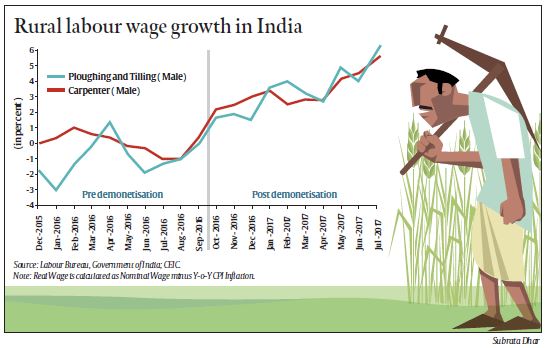
He says now that 99% of notes have returned to banks, demonetisation should be judged on whether tax compliance improves from current 25% level. Personal tax data will show what is happening. However author is able to show that growth of real wages of lower wage earners has doubled post-demonetisation from 2% to 5%. All this suggests growth can go back up if situation is well managed.
Author is somewhat critical on GST and its implementation. Whilst GST is a good reform, govt should lower exorbitant GST rates —and flexibility to do so will be known after a while. Issues have cropped up (like slow refunds & difficulty in filling returns) and tweaks are being made. Much depends on how govt improves GST and reduces the burden on small businesses.
http://indianexpress.com/article/opinion/columns/yashwant-sinha-article-on-indian-economy-demonetisation-gst-narendra-modi-arun-jaitley-4867559/
2. What to make of India's growth under NDA govt?
-----------------------------------------------------------------------------
Arvind Panagariya (former head of Niti Aayog) states that key indicators for 2014-16 back up the high 7.5% growth rate in the first 2 years of NDA. For example, corporate savings growth (from 2014-16) was 11.8%pa while during India's last high growth era (2003-2012) it was 7.4%pa. Corporate investments growth was 12.95% vs 12.4%, and GCF was 31.9% GDP vs 34.6% GDP.
Those who pointed to distress in construction, steel and power had overlooked thriving sectors like auto, auto parts, 2-wheelers, pharmaceuticals and IT.
Author states that naysayers are overplaying the fall in GDP in last two quarters to 6.1% and 5.7%. He maintains that, "any claims of fundamental weakness in the economy are so far unsupported by data"— because data on key indicators is not available for 2016-17. "Decline can be explained by the massive restructuring of the economy, due to demonetisation, GST and cleaning up of bad bank loans".
There are two well know problems:
1. Twin balance sheet problem (indebted companies & bank NPAs): RBI has already tackled it on its side. Now govt should accelerate bank recapitalization!
2. Merchandise exports (excl petroleum) have fallen from $281 billion in 2012 to $229 billion in 2016. This is a perennial problem. Author suggests inducing a slight fall in Rupee and work on export oriented growth for the longer term, incl trade facilitation and coastal economic zones.
Comment
--------------
Author has not said anything radical. Whilst growth has fallen a little (from 7.5% to 5.9% in half a year), it comes at time of great disruption. I don't agree with devaluing the Rupee and exports are a problem for all govts (ie. negative balance of trade, esp with China). Main options for exports are to improve competitiveness at home (ie with reforms that govt is implementing) and more export-oriented FDIs. Govt should also speed up trade facilitation & coastal economic zones.
3. Disruptive effects of Govt financial actions
-------------------------------------------------------------------------
Anti-corruption, formalization, digitalisaton, GST and data analytics will garner taxes and better compliance. Other specific actions add to better compliance (eg environmental monitoring, improved testing, digital records, remote contact, trained staff, little or no discretion, clampdown on collusion, tough penalties, active prosecutions).
GST will reduce tax distortions to trade. In India, multiple taxes on traded items had encouraged large firm that produced everything. Specialist firms (which were best at what they did) will become the norm and these will trade more intensively.
Weak firms survived though cheating on regulations, political favours or policies that propped up zombie (insolvent) company. These inefficient firms cant compete in world markets but take away resources and opportunities from strong firms that can eventually compete. RBI reforms, Insolvency & Bankruptcy code and Resolution corporations have shifted capital from zombie to healthy firms. Good borrowers and productive sectors will now get easier terms as resources are shifted out of black money assets and zombie firms.
Responses for firms
------------------------------
Firms will reassess all aspects like logistics, suppliers, technology partnerships, markets, whether to deleverage or add new capital. Highly productive firms can buy assets of weaker firms and improve them (esp insolvent assets). Vertically integrated firms will voluntarily divest non-core parts & increasingly move out of unproductive activities.
Task for policy makers
--------------------------------
1. Improve GST by adding petroleum, single rate, lower rates and better admin
2. Continue to improve bankruptcy processes - create a pool of buyers of distressed assets, tweaks in law, raise qualified professionals, etc
3. Further improve RBI regulation of banks
http://www.mayin.org/ajayshah/MEDIA/2017/reallocation.html
http://economictimes.indiatimes.com/tech/ites/lt-infotech-bags-100-mn-contract-to-help-pin-down-tax-evaders/articleshow/60900040.cms
4. Govt actions viewed from WEF competitiveness index
-------------------------------------------------------------------------------------
Private sector sees corruption as the most problematic issue for doing business. ¶ Actions against corruption should have a positive impact on competitiveness (eg actions against shell companies & Benami properties, pursuit of financial crimes, prosecution of political scams and wilful defaulters, scamsters forced to payback money, start in reducing harassment) besides financial reforms.
¶ Govt investment ("massive funding to bankroll new infra") has seen India edge up in "most pillars of competitiveness, in particular, Infrastructure (66th, up by two), Higher education and training (75th, up by six), and Technological readiness (107th, up by three)".
¶ Disruptive competition by Jio backed by govt actions (eg Bharatnet, public Wifi, more comm towers, also, Demonetization, GST) has caused sharp falls in cost of data comm. and boosted the digital economy. WEF report lauds, "improvements in ICT (information and communication technologies) such as bandwidth per user, mobile phone and broadband subscriptions, and Internet access in schools". It has scaled up targets for mobile and high-speed internet access to 550-650m by 2020.
Technology readiness
---------------------------------
India has Innovative capabilities, but scored poorly in Technology readiness. ¶ Smart cities mission should see major tech infusion into public administration (eg face scanners/ fingerprint detectors at police stations & digital sharing of police information). Strong technology drive is seen elsewhere:
▬ Automation (eg ¶ Railways is automating ticketing, vending, signaling, track laying and fault finding)
▬ Mechanization (eg ¶ surge for tilling machines is backed by govt grants to reduce crop burning)
▬ Tech solutions (eg. ¶ surge in drip irrigation for sugarcane crops, supported by govt grants, ¶ e-banking, e-retailing, tele-education & tele-health)
▬ Industrialization (eg ¶ explosive growth in sanctioned food processing units, ¶ Textile technology upgrade package)
▬ New age manufacturing (eg. ¶ Strategic defense partnership will bring latest Western defense manufacturing and be adopted by Indian private enterprises. ¶ Carbon-fibre frames of fighters and warships¶ In-country manufacture of bullet trains)
▬ Leapfrogging infra (eg. ¶ Solar panels, EV buses, EV batteries, battery swapping & charging points ¶ Fast breeder nuclear reactors).
http://www.livemint.com/Politics/QdQ4zRhlA2GRT0pNSWktiN/India-improves-on-WEFs-global-competitiveness-rankings.html
5. Themes for future growth
-------------------------------------------
—✽Raising economic activity among poorer sections✽—
It is perhaps the easiest given latent demand for goods & services. Efforts made for uplifting social well-being like access to good sanitation, education, health, energy, rural roads and communications will also create new job opportunities. Vast amounts of unsecured loans have been given to small operators and enterprises; and through this, benefits will be seen in the middle class and emerging middle class.
—✽Financial reforms✽—
Major financial reforms will improve the health of productive sectors of Indian economy (see point 3). These include game changing reforms like Aadhaar, DBT, GST, bankruptcy code, tax treaty revisions, Benami properties and digital transactions. Hoards of black money are being channeled into financial assets and banks. Other reforms are Ease of doing Business and emphasis on Make in India (incl incentives for textile and electronics).
—✽Corrective actions taken in key sectors✽—
Govt has improved the situation in these sectors: agriculture, power, coal, steel, roads, railways, telecom and public sector enterprises. ¶ Irrigation, food processing, soil health cards and market reforms are part of 7-point agenda to uplift agricultural incomes. ¶ Joined up power reforms are efforts to improve delivery along the whole value chain, incl coal shortages, viability of renewable power, transmission bottlenecks, discom health and upgrades to distribution. ¶ Distribution has seen major action, like rural electrification, underground power lines via smart cities, subsidized household connections, smart metering and energy efficiency. ¶ Trade measures and higher infra demand has brought back steel from bank default situation. ¶ Reducing cost of logistics, easing commuter woes and geographical expansion have been the major thrust of public investment with projects like building Delhi orbital expressways, fast tracking doubling of railway track, improving efficiency of major ports and many bridges and railway connections in NE India . ¶ Telecoms has seen explosive growth in data due to intense competition from a new entrant. ¶ Modernization, expansion, profitability & improved competitiveness are major themes for Steel PSUs like SAIL, Major ports, Oil PSUs, BSNL. Strategic divestment is coming to fore like Air India sell-off.
—✽Higher tax compliance✽—
Higher tax revenues can support the next investment boom. Part will be spent for building affordable housing on a massive scale. Higher tax revenues should see improvement in credit ratings.
—✽Much more can be done✽—
More can be done like
▬ focused approach to improving competitiveness (sectors aim to be leading lights in their field)
▬ coastal economic zones
▬ knowledge economy (standards of education, training, research and development, quality of thought process, breaking down barriers for others)
▬ extreme focus on manufacturing (doing whatever is necessary from design to marketing to send products to top shelves, incl sourcing IIPs, quality tsars, cornering distribution, pushing products to foreign markets, providing opportunities to best Indian suppliers)
▬ opening up retail sector
▬ bringing in technologies in a big way (by going this route, disruption to status quo will give way to better jobs, quality products & services and better life styles)
▬ removing ailments plaguing country (road & rail casualties, impact of natural disasters, law and order, pending cases, sickness and disease, pollution and congestion, official waste of time, non-participation of women in work place, various criminal acts incl fake education, fake driving licences, destroying public property, harassment, bribe giving, political scams)
2. What to make of India's growth under NDA govt?
3. Disruptive effects of Govt financial actions
4. Govt actions viewed from WEF competitiveness index
5. Themes for future growth
6. Effect of financial reforms: sharp falls seen in informal lending
7. GST sets a high bar for compliance
8. RERA and Asset Quality Review are also high impact reforms
9. Surat's unorganized diamond polishing biz is suffering the most — and losing business to big established firms
1. Counter to naysayers
Surjit S Bhalla riles against gossip or non-factual criticism of naysayers. Most comes from well entrenched opposition to the govt and can easily be dismissed. Criticism of the new GDP series is not well founded as proponents have ignored positive indicators supporting GDP growth (see point 2).
Author states that the economy is not on a downward spiral. Serious deceleration showed up only in last 2 quarters. RBI has contributed to the slow down by holding rates constant while inflation has fallen. This has raised real repo rate by 200 basis points. At 370 bp India is second worst among emerging markets, and that is not correct by any reckoning.
He says now that 99% of notes have returned to banks, demonetisation should be judged on whether tax compliance improves from current 25% level. Personal tax data will show what is happening. However author is able to show that growth of real wages of lower wage earners has doubled post-demonetisation from 2% to 5%. All this suggests growth can go back up if situation is well managed.
Author is somewhat critical on GST and its implementation. Whilst GST is a good reform, govt should lower exorbitant GST rates —and flexibility to do so will be known after a while. Issues have cropped up (like slow refunds & difficulty in filling returns) and tweaks are being made. Much depends on how govt improves GST and reduces the burden on small businesses.
http://indianexpress.com/article/opinion/columns/yashwant-sinha-article-on-indian-economy-demonetisation-gst-narendra-modi-arun-jaitley-4867559/
2. What to make of India's growth under NDA govt?
Arvind Panagariya (former head of Niti Aayog) states that key indicators for 2014-16 back up the high 7.5% growth rate in the first 2 years of NDA. For example, corporate savings growth (from 2014-16) was 11.8%pa while during India's last high growth era (2003-2012) it was 7.4%pa. Corporate investments growth was 12.95% vs 12.4%, and GCF was 31.9% GDP vs 34.6% GDP.
Those who pointed to distress in construction, steel and power had overlooked thriving sectors like auto, auto parts, 2-wheelers, pharmaceuticals and IT.
Author states that naysayers are overplaying the fall in GDP in last two quarters to 6.1% and 5.7%. He maintains that, "any claims of fundamental weakness in the economy are so far unsupported by data"— because data on key indicators is not available for 2016-17. "Decline can be explained by the massive restructuring of the economy, due to demonetisation, GST and cleaning up of bad bank loans".
There are two well know problems:
1. Twin balance sheet problem (indebted companies & bank NPAs): RBI has already tackled it on its side. Now govt should accelerate bank recapitalization!
2. Merchandise exports (excl petroleum) have fallen from $281 billion in 2012 to $229 billion in 2016. This is a perennial problem. Author suggests inducing a slight fall in Rupee and work on export oriented growth for the longer term, incl trade facilitation and coastal economic zones.
Comment
Author has not said anything radical. Whilst growth has fallen a little (from 7.5% to 5.9% in half a year), it comes at time of great disruption. I don't agree with devaluing the Rupee and exports are a problem for all govts (ie. negative balance of trade, esp with China). Main options for exports are to improve competitiveness at home (ie with reforms that govt is implementing) and more export-oriented FDIs. Govt should also speed up trade facilitation & coastal economic zones.
3. Disruptive effects of Govt financial actions
Anti-corruption, formalization, digitalisaton, GST and data analytics will garner taxes and better compliance. Other specific actions add to better compliance (eg environmental monitoring, improved testing, digital records, remote contact, trained staff, little or no discretion, clampdown on collusion, tough penalties, active prosecutions).
GST will reduce tax distortions to trade. In India, multiple taxes on traded items had encouraged large firm that produced everything. Specialist firms (which were best at what they did) will become the norm and these will trade more intensively.
Weak firms survived though cheating on regulations, political favours or policies that propped up zombie (insolvent) company. These inefficient firms cant compete in world markets but take away resources and opportunities from strong firms that can eventually compete. RBI reforms, Insolvency & Bankruptcy code and Resolution corporations have shifted capital from zombie to healthy firms. Good borrowers and productive sectors will now get easier terms as resources are shifted out of black money assets and zombie firms.
Responses for firms
Firms will reassess all aspects like logistics, suppliers, technology partnerships, markets, whether to deleverage or add new capital. Highly productive firms can buy assets of weaker firms and improve them (esp insolvent assets). Vertically integrated firms will voluntarily divest non-core parts & increasingly move out of unproductive activities.
Task for policy makers
1. Improve GST by adding petroleum, single rate, lower rates and better admin
2. Continue to improve bankruptcy processes - create a pool of buyers of distressed assets, tweaks in law, raise qualified professionals, etc
3. Further improve RBI regulation of banks
http://www.mayin.org/ajayshah/MEDIA/2017/reallocation.html
http://economictimes.indiatimes.com/tech/ites/lt-infotech-bags-100-mn-contract-to-help-pin-down-tax-evaders/articleshow/60900040.cms
4. Govt actions viewed from WEF competitiveness index
Private sector sees corruption as the most problematic issue for doing business. ¶ Actions against corruption should have a positive impact on competitiveness (eg actions against shell companies & Benami properties, pursuit of financial crimes, prosecution of political scams and wilful defaulters, scamsters forced to payback money, start in reducing harassment) besides financial reforms.
¶ Govt investment ("massive funding to bankroll new infra") has seen India edge up in "most pillars of competitiveness, in particular, Infrastructure (66th, up by two), Higher education and training (75th, up by six), and Technological readiness (107th, up by three)".
¶ Disruptive competition by Jio backed by govt actions (eg Bharatnet, public Wifi, more comm towers, also, Demonetization, GST) has caused sharp falls in cost of data comm. and boosted the digital economy. WEF report lauds, "improvements in ICT (information and communication technologies) such as bandwidth per user, mobile phone and broadband subscriptions, and Internet access in schools". It has scaled up targets for mobile and high-speed internet access to 550-650m by 2020.
Technology readiness
India has Innovative capabilities, but scored poorly in Technology readiness. ¶ Smart cities mission should see major tech infusion into public administration (eg face scanners/ fingerprint detectors at police stations & digital sharing of police information). Strong technology drive is seen elsewhere:
▬ Automation (eg ¶ Railways is automating ticketing, vending, signaling, track laying and fault finding)
▬ Mechanization (eg ¶ surge for tilling machines is backed by govt grants to reduce crop burning)
▬ Tech solutions (eg. ¶ surge in drip irrigation for sugarcane crops, supported by govt grants, ¶ e-banking, e-retailing, tele-education & tele-health)
▬ Industrialization (eg ¶ explosive growth in sanctioned food processing units, ¶ Textile technology upgrade package)
▬ New age manufacturing (eg. ¶ Strategic defense partnership will bring latest Western defense manufacturing and be adopted by Indian private enterprises. ¶ Carbon-fibre frames of fighters and warships¶ In-country manufacture of bullet trains)
▬ Leapfrogging infra (eg. ¶ Solar panels, EV buses, EV batteries, battery swapping & charging points ¶ Fast breeder nuclear reactors).
http://www.livemint.com/Politics/QdQ4zRhlA2GRT0pNSWktiN/India-improves-on-WEFs-global-competitiveness-rankings.html
5. Themes for future growth
—✽Raising economic activity among poorer sections✽—
It is perhaps the easiest given latent demand for goods & services. Efforts made for uplifting social well-being like access to good sanitation, education, health, energy, rural roads and communications will also create new job opportunities. Vast amounts of unsecured loans have been given to small operators and enterprises; and through this, benefits will be seen in the middle class and emerging middle class.
—✽Financial reforms✽—
Major financial reforms will improve the health of productive sectors of Indian economy (see point 3). These include game changing reforms like Aadhaar, DBT, GST, bankruptcy code, tax treaty revisions, Benami properties and digital transactions. Hoards of black money are being channeled into financial assets and banks. Other reforms are Ease of doing Business and emphasis on Make in India (incl incentives for textile and electronics).
—✽Corrective actions taken in key sectors✽—
Govt has improved the situation in these sectors: agriculture, power, coal, steel, roads, railways, telecom and public sector enterprises. ¶ Irrigation, food processing, soil health cards and market reforms are part of 7-point agenda to uplift agricultural incomes. ¶ Joined up power reforms are efforts to improve delivery along the whole value chain, incl coal shortages, viability of renewable power, transmission bottlenecks, discom health and upgrades to distribution. ¶ Distribution has seen major action, like rural electrification, underground power lines via smart cities, subsidized household connections, smart metering and energy efficiency. ¶ Trade measures and higher infra demand has brought back steel from bank default situation. ¶ Reducing cost of logistics, easing commuter woes and geographical expansion have been the major thrust of public investment with projects like building Delhi orbital expressways, fast tracking doubling of railway track, improving efficiency of major ports and many bridges and railway connections in NE India . ¶ Telecoms has seen explosive growth in data due to intense competition from a new entrant. ¶ Modernization, expansion, profitability & improved competitiveness are major themes for Steel PSUs like SAIL, Major ports, Oil PSUs, BSNL. Strategic divestment is coming to fore like Air India sell-off.
—✽Higher tax compliance✽—
Higher tax revenues can support the next investment boom. Part will be spent for building affordable housing on a massive scale. Higher tax revenues should see improvement in credit ratings.
—✽Much more can be done✽—
More can be done like
▬ focused approach to improving competitiveness (sectors aim to be leading lights in their field)
▬ coastal economic zones
▬ knowledge economy (standards of education, training, research and development, quality of thought process, breaking down barriers for others)
▬ extreme focus on manufacturing (doing whatever is necessary from design to marketing to send products to top shelves, incl sourcing IIPs, quality tsars, cornering distribution, pushing products to foreign markets, providing opportunities to best Indian suppliers)
▬ opening up retail sector
▬ bringing in technologies in a big way (by going this route, disruption to status quo will give way to better jobs, quality products & services and better life styles)
▬ removing ailments plaguing country (road & rail casualties, impact of natural disasters, law and order, pending cases, sickness and disease, pollution and congestion, official waste of time, non-participation of women in work place, various criminal acts incl fake education, fake driving licences, destroying public property, harassment, bribe giving, political scams)
View: What impending doom? Hard data shows India under Modi is flourishing

economictimes.indiatimes.com
6
1
- Doubling the pace of growth of real wages of the poor is an overlooked positive of demonetization.
REPLY Oct 7, 2017 - Point 6
Effect of financial reforms: sharp falls seen in informal lending
Volumes have fallen sharply in last 6-9 months, even as rates have dipped to 1/3rd from 9-18% to 6%. Earlier the shady credit market was a favourite for local politicians, industrialists and local traders, whosoever had unaccounted cash. Tax dodge made it easier to pay very high rates on informal credit. Now people are uneasy about dealing in cash. Hiding transactions has become hard under GST.
REPLY Oct 7, 2017 - Point 7
GST sets a very high bar for compliance
GST is a highly IT driven system and self-policing. GST demands very high disciple from taxpayers. Collection and matching of invoices is a key feature. Invoice matching was a requirement earlier in 9 states incl Karn, Guj, UP, TN, AP, Kerala. Rebates then were issued merely on presenting the invoice. Now rebates are issued only when matching tax is paid by suppliers of that purchase.
Massive scale of the roll-out has challenged the IT infra and created issues for policymakers. Problems have occurred and need to be promptly fixed. Informal sector was disrupted, small business had difficulty in filing monthly returns and destocking has lead to deceleration of growth in April-June quarter.
GSTN network shut down due to volumes. IT firm has been ordered to increase server capacity and remedy all other glitches. Informal firms have to decide on a course of action—if they remain informal, they can't avail tax credit and can't offer services to registered suppliers, but formalizing means painful adjustment for compliance and future impacts on direct taxes. Small businesses have been hardest hit, as they had least IT resources (eg 60% of traders did'nt have computers). Lack of awareness and education is common in small towns. Whilst filing returns, business have not received input tax and may be concerned about claiming credit. Govt has extended deadline to file summary returns and detailed invoice returns. It may need to do much more.
Though logistics has seen an immediate benefit, the boost, even in logistics, is more in the medium-term. Some of the impact on the economy due to destocking has started to ease. GST tax collection dipped 3.6% in August (2nd month). But only half the assessees had filed returns, so that is not the final figure. It is also not known if some states have fallen short of their targets, for which Centre is committed to compensate fully.
"There are no widespread protests, except for textiles. A lot can be done to fine-tune the new system: Procedural simplification, trimming tax slabs, addressing concerns of exports and SMEs."
REPLY Nov 26, 2017 - Point 8
RERA and Asset Quality Review are also high impact reforms
RERA and Asset Quality Review are often forgotten reforms that have also led to some slowdown. RERA (from 1/5/17) aims to regulate the construction sector, protect consumers and reduce corruption. While it will lead to supply-side issues, especially affecting builders with suspect practices, it is a net positive in the medium-term.
Asset Quality Review (2015-16) forces banks to frequently and critically review their loans and provisions more aggressively for suspect loans. Credit growth is hit as monies are diverted to provisioning and banks become more conservative in lending. In the long-term, the doing away of corrupt practices (eg. politically influenced loans, bribery, fraud) and improving lending practices more generally, will be a net positive.
REPLY Nov 26, 2017 - Point 9
Surat's unorganized diamond polishing biz is suffering the most — and losing business to big established firms
REPLY Oct 14, 2017 REPLY Oct 7, 2017


Add a comment...

No comments:
Post a Comment