
Promoting electric vehicles over hybrids
❡— Most countries have approached green mobility by first promoting hybrids, then plug-in hybrids, and finally all-electric cars. Norway took 30 years to reach a stage where it could switch-over to electric cars by 2025 ❡— India is attempting to get to that future sooner by concentrating on just electric vehicles.
❡—Indian policy has halted manufacturers' plans on hybrids, but it will surely bring an influx of electric cars in the near future. Until then there is the Mahindra e2o Plus, e-Verito and e-Supro 3, which will keep the electric car market going ❡—
https://www.drivespark.com/four-wheelers/2017/gst-effect-hybrids-electric-cars-right-move-022869.html
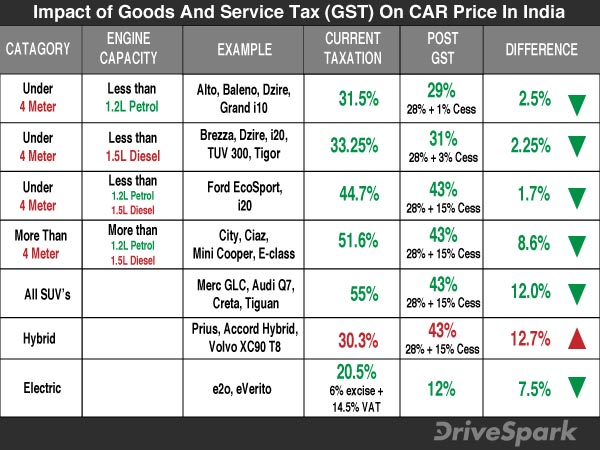
Like China, Indian govt is favouring electric-only vehicles over hybrid ones. Whilst it lowered GST on electric vehicles to a low 12%, it raised it on hybrids by 13% to 43%. In the very next quarter ending Sept 2017, sales of hybrids saw a sharp fall. Production of many hybrids came to an abrupt halt!!
Govt policy seeks to stimulate consumer interest in EVs -- and, hopes that manufacturers will bring out EV models, that EVs sales will propel medium term profitability and in turn bring all parties together to build a completely new EV ecosystem. On the other hand, hybrids owners are not severely hampered by the lack of charging points, and their sales will not compel the same response.
❡— Most countries have approached green mobility by first promoting hybrids, then plug-in hybrids, and finally all-electric cars. Norway took 30 years to reach a stage where it could switch-over to electric cars by 2025 ❡— India is attempting to get to that future sooner by concentrating on just electric vehicles.
❡—Indian policy has halted manufacturers' plans on hybrids, but it will surely bring an influx of electric cars in the near future. Until then there is the Mahindra e2o Plus, e-Verito and e-Supro 3, which will keep the electric car market going ❡—
https://www.drivespark.com/four-wheelers/2017/gst-effect-hybrids-electric-cars-right-move-022869.html
Like China, Indian govt is favouring electric-only vehicles over hybrid ones. Whilst it lowered GST on electric vehicles to a low 12%, it raised it on hybrids by 13% to 43%. In the very next quarter ending Sept 2017, sales of hybrids saw a sharp fall. Production of many hybrids came to an abrupt halt!!
Govt policy seeks to stimulate consumer interest in EVs -- and, hopes that manufacturers will bring out EV models, that EVs sales will propel medium term profitability and in turn bring all parties together to build a completely new EV ecosystem. On the other hand, hybrids owners are not severely hampered by the lack of charging points, and their sales will not compel the same response.

11
Shared publicly
Hide 5 comments
- It can be seen that electric-only vehicles have a low 12% GST, as against others that have rates of 28% + cess. Introduction of GST regime in July 2017 saw the tax on EVs fall by 7.5%, but the tax on hybrids was increased from 30% → 43%. NB. GST rates for normal vehicles were revised upwards in Sept 2017 (eg SUV are now taxed at 50%).
https://www.drivespark.com/four-wheelers/2017/gst-effect-hybrids-electric-cars-right-move-022869.html
REPLY 40w - "Toyota stopped production in September quarter after the hybrid’s sales dropped 73%."
REPLY 41w - Hybrid of Ciaz contributed 32% of total Ciaz sales for the September quarter compared to 70% a year ago -- Maruti
REPLY 41w - Some advocate a stronger push for e-buses. E-buses will definitely be easier in terms of charging points, battery swaps and financial support. OTOH govt auctions for e-cars signals an aggressive push for EVs as it requires setting up city-wide charging points, etc. This can kick-start adoption by the private sector (taxis, office fleet, commercial vehicles) and the general public.
REPLY 40w - Li batteries technology is now dispensed to the private sector. But can Indian production compete with China, and reduce prices over time by garnering efficiencies of scale?
REPLY 40w - PowerGrid will set up fast-charging point at Hyderabad metro station
-- Full charge takes 30 min
CEO says, "public sector has to push e-vehicles infra before private sector comes in with big investments."
-- Rail stations are ideal for sitting charging points.
-----------------------------------------
PowerGrid's green grid corridors project is ahead of schedule. HVDC is a highly efficient, modern technology that has the least line losses. As such, green corridors are highly desirable.
PG has already completed some transmission lines, and some are nearing completion, eg:
i) Champa to Kurukshetra HVDC line (end 2018)
ii) Raigarh to Pugalur HVDC (mid-2019)
REPLY 39w - Indian passenger electric vehicles will be primarily driven by government and corporate procurements over the next four years, a study report has said.
“India’s car market is driven by very affordable (below $10,000) small vehicles, and the Indian government has not shown any appetite to provide subsidies that would be required to make electric passenger vehicles affordable for private citizens in the short term,” it said.
Based on the procurement trends, annual passenger electric vehicle (EV) sales may reach 30,000 units by 2022, compared to only 2,000 units in 2017, Bloomberg New Energy Finance said in its ‘Long-term electric vehicle outlook 2018’ report on Friday.
And, low average vehicle prices will inhibit EV uptake for the next 10 years before adoption rises in the 2020s, the study said. “Progress on e-bikes, rickshaws and e-buses looks promising over the next 10 years. But, we expect EVs to represent just 10 per cent of India’s total passenger vehicle fleet in 2040,” the report said.
It also said that instead of following China, India has different opportunities for the electrification in transport sector. Electric two-wheelers and three-wheelers look much promising for the next 10 years.
“India is a priority country for Bloomberg globally, and one whose power and transport sectors are expected to fundamentally change by mid-century with its economic transformation,” Jon Moore, Chief Executive Officer, Bloomberg NEF, said here. India is often touted as the next big electric vehicle market set to follow China’s lead. However, low average vehicle prices will inhibit EV uptake for the next 10 years, Ashish Sethia, Head of Research, Asia Pacific for Bloomberg NEF, said.
“After 2030, we expect EV sales in India to accelerate with increased affordability, as well as the government’s efforts to ensure universal access to electricity which lower challenges with charging infrastructure,” he said.
REPLY 37w REPLY 36w - Charging points/ EV ecosystem investment as CSR and accelerated depreciation for EVs (50% vs 15% pa)
REPLY 36w REPLY 36w REPLY 36w


Add a comment...

No comments:
Post a Comment