
DEVELOPMENT OF NORTH EAST INDIA
〰️〰️〰️〰️〰️〰️〰️〰️〰️〰️〰️〰️〰️
——✽VISION for NORTH EAST✽——
North East: better connected and trading with its neighbours
———————————————————————————
A clear vision and good action plans are required to sustain a continuous forward momentum for development, to meet timelines and show results. North East forums can be places where NE states exchange ideas with neighbouring countries and states. Outreach to rest of India can be done by exchanging festivals, sports and other such events. Private sector participation in discussions is helpful. As a result of interactions, NE Industrial policy will soon be notified to tackle industry’s concerns. After some improvements in road and railways, digital connectivity and air connectivity now need the biggest push. Scientific interventions are required in farm and non-farm sectors, so that gaps are identified and then remedied with suitable technology. Agricultural marketing needs to be overhauled to revive important sectors like tea. It is understood that any development must be done in an ecologically, sustainable way.
Look East policy of Centre requires North East to be made strong and stable, so it can be a bridge to neighbouring countries. Ministry of External Affairs is integrating NE by promoting sub-regional trade and connectivity in various India-ASEAN Connectivity and Business Summits. Manipur will become a throughfare for trade with SE Asia. Rail connectivity to Imphal is being expedited for completion by 2019. Handicrafts and textile industry, will be among many other activities that benefit.
Potential exists in the North East for tourism, medical tourism, IT, handicraft, bamboo, organic farming, cross-border regional value chain, infrastructure development etc. For purpose of promoting such enterprises, govt has established agencies & programmes, such as:
1. North East Council to development of the tourism sector
2. North East Rural Livelihood Programme
3. SAMPADA for food processing, cold chains, storage, transport
Road, rail, waterways and pipeline connectivity is being strongly pushed to neighbouring countries.
✔️ Road and rail connectivity to bordering nations is being prompted by Motor Vehicles pact. Old railway lines via Bangladesh are being opened.
✔️ Development of National Waterway-2 & connection to NW-1 via Bangladesh is underway. A shift of just coal, fly ash & foods to waterways shows a 35% return of economic benefit to the region. There are 19 other unexploited waterways.
✔️ Under-sea internet cable will connect NE from Bangladesh
✔️ Gas and oil pipelines from Bangladesh port will feed southern NE India. Reverse will happen in Northern region.
Development of NE can benefit rest of India
————————————————————————
✔️ Tourism & hospitality sectors are being promoted. Tour operators are including packages for adventure tours and holidays to destinations like Meghalaya, Sikkim and Arunachal Pradesh.
✔️ Film shooting has good potential. Film and Television Institute is planned for Arunachal.
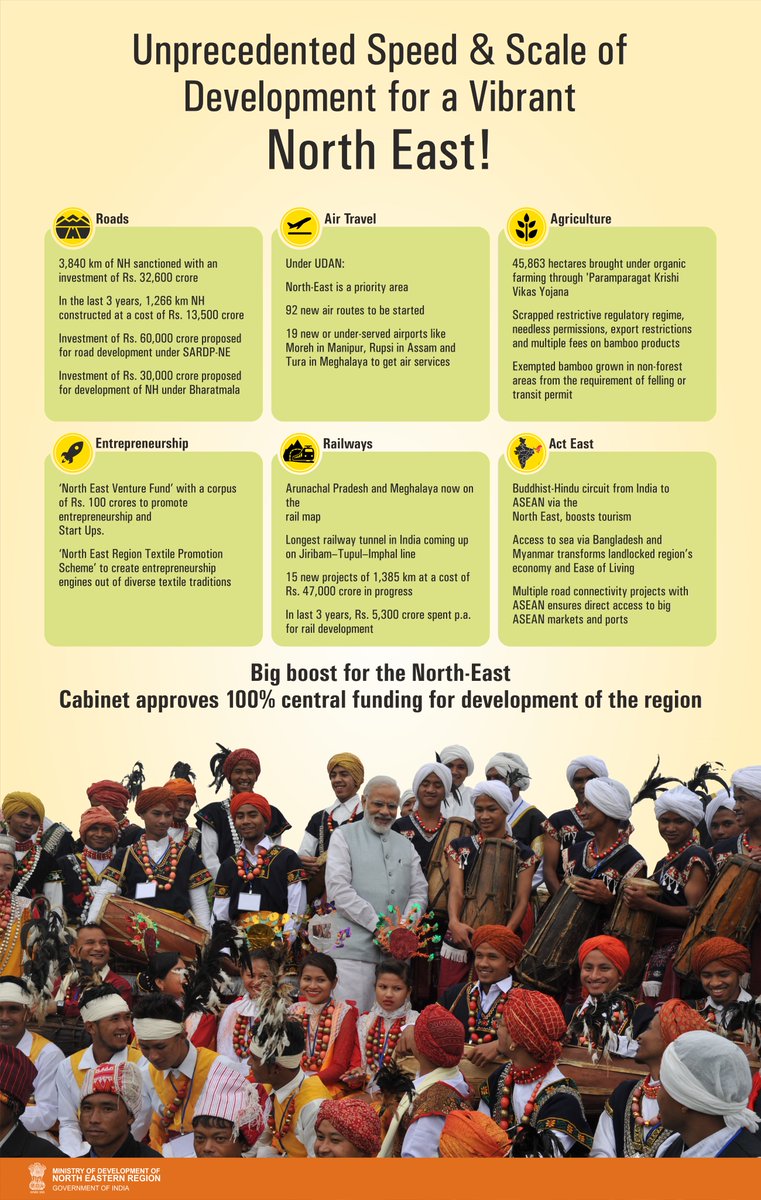
✔️ Higher supply of bamboo can meet domestic demand for timber. Bamboo goods manufacturing was boosted by Centre decision to classify bamboo as a crop and not as a forest. Existing bamboo areas can now be exploited for agriculture, thus bamboo will become widely available to industry. Local processing will be done to benefit local people.
NE is an unexplored region with much to offer in Agriculture
———————————————————————
✔️ Sikkim is an organic food state. Rest of NE can be developed thus and the region can become an export hub for organic food.
✔️ Mega Food Parks will come up in Assam, Tripura and Mizoram. Food processing and storage are profitable avenues, as 40% of fruit goes to waste and there are surpluses to exploit, eg. NE produces 45% of pineapples, is 4th in oranges and 1st in cardamom.
✔️ NE has many varieties of bamboo, rice, etc which can be harnessed in research. Mizoram is bio-diversity rich state worthy of exploration.
➡️ Govt has introduced NE Road Sector Development Scheme to built road connections through neglected segments.
➡️ NE venture capital fund has been set up. It already has 65 proposals for investment. Start-up scheme is being encouraged for private investment.
Large dam storage in Arunachal P can bring long-term prosperity
———————————————————————
Chinese threat to divert upto 80% of 18 BCM flow away from India has compelled experts to think of building massive storage facilities of 14BCM. This is intended to mitigate shortages during the lean season from Nov to Apr, but will have other benefits. Reservoirs will help control annual floods in Assam, as Brahmaputra becomes uncontrollably swollen in the rainy season. A 9.2 BCM storage dam will be attached to 10,000MW Upper Siang HE project. Remaining storage will cater for HE projects on rivers Lohit, Subansiri and Dibang in Arunachal Pradesh.
Central ministers have given a push to it, beware there is stiff local resistance. States have been asked to come back with compensation estimates. Tectonic sensitivity and submergance of forests must also be addressed. Centre has assured full funding including loan as it doesn’t want the project derailed by Chinese pressure on foreign investors.
➡️ Though strategic in nature and deserving of the highest priority, it is also equitable that tribal communities are personally benefited, and their way of life is not marginalized by such fast-paced developments.
——✽CONNECTIVITY for NORTH EAST✽——
Many deride the basis for building as just for military and dam projects. Patchwork approach to roads has left gaps like unfinished bridges. During monsoon, people must revert to old routes, which means very lengthy diversion from E. Arunachal to southern banks in Assam (crossing at Tezpur) then tracking back north of river.
Connectivity by bridges
—————————————
✔️ Bhupen Hazarika Bridge has been built. This will bring a wave of development in upper Assam and Arunachal across Brahmaputra.
✔️ Superstructure of Bogibeel bridge will be completed when the final girdle is laid by November. Rail tracks and road connection from North and South transit points will take another 5-6 months, due to delays at some stretches.
✔️ Multiple bridges at Guwahati to decongest and build a new city on north bank of Brahmaputra.
Air connectivity
----------------------
Air travel becomes important because roads are inadequate and difficult in hilly NE. Timetable for road building is too stretched.
➡️ Guwahati International Airport will have direct connectivity to SE Asian countries. 300 daily fights are contemplated, where Assam will become a hub for trade in NE.
▬ Imphal international airport missed out.
➡️ Air India will operate frequent direct flight from Imphal to New Delhi. There is interest in doing the same with other major cities in India.
➡️ Phase II of UDAN scheme has expanded air connectivity. 92 new routes will provide no-frills service by private carriers.
➡️ 19 new (or underutilized) airports will be added to civil network. 1st airport of Sikkim, at Pakyong in northernmost part of Sikkim was completed (tourism at Nathu La Pass).
➡️ 7 new heliports will be opened in the region
➡️ Helicopter dispensary/OPD service in far-flung areas of the region by the beginning of 2018. Two premier medical facilities will be connected.
▬ Spicejet will employ 9-10 small seaplanes, which can land in small airstrips.
Road and rail connectivity at Tibet border
—————————————————————
http://indiatoday.intoday.in/story/army-plans-tunnels-between-ladakh-and-arunachal-to-counter-growing-chinese-presence-along-lac/1/1090528.html
Connectivity within NE
—————————————
http://www.thehindubusinessline.com/economy/logistics/highway-construction-projects-in-northeast-moving-at-snails-pace/article9944158.ec
〰️〰️〰️〰️〰️〰️〰️〰️〰️〰️〰️〰️〰️
——✽VISION for NORTH EAST✽——
North East: better connected and trading with its neighbours
———————————————————————————
A clear vision and good action plans are required to sustain a continuous forward momentum for development, to meet timelines and show results. North East forums can be places where NE states exchange ideas with neighbouring countries and states. Outreach to rest of India can be done by exchanging festivals, sports and other such events. Private sector participation in discussions is helpful. As a result of interactions, NE Industrial policy will soon be notified to tackle industry’s concerns. After some improvements in road and railways, digital connectivity and air connectivity now need the biggest push. Scientific interventions are required in farm and non-farm sectors, so that gaps are identified and then remedied with suitable technology. Agricultural marketing needs to be overhauled to revive important sectors like tea. It is understood that any development must be done in an ecologically, sustainable way.
Look East policy of Centre requires North East to be made strong and stable, so it can be a bridge to neighbouring countries. Ministry of External Affairs is integrating NE by promoting sub-regional trade and connectivity in various India-ASEAN Connectivity and Business Summits. Manipur will become a throughfare for trade with SE Asia. Rail connectivity to Imphal is being expedited for completion by 2019. Handicrafts and textile industry, will be among many other activities that benefit.
Potential exists in the North East for tourism, medical tourism, IT, handicraft, bamboo, organic farming, cross-border regional value chain, infrastructure development etc. For purpose of promoting such enterprises, govt has established agencies & programmes, such as:
1. North East Council to development of the tourism sector
2. North East Rural Livelihood Programme
3. SAMPADA for food processing, cold chains, storage, transport
Road, rail, waterways and pipeline connectivity is being strongly pushed to neighbouring countries.
✔️ Road and rail connectivity to bordering nations is being prompted by Motor Vehicles pact. Old railway lines via Bangladesh are being opened.
✔️ Development of National Waterway-2 & connection to NW-1 via Bangladesh is underway. A shift of just coal, fly ash & foods to waterways shows a 35% return of economic benefit to the region. There are 19 other unexploited waterways.
✔️ Under-sea internet cable will connect NE from Bangladesh
✔️ Gas and oil pipelines from Bangladesh port will feed southern NE India. Reverse will happen in Northern region.
Development of NE can benefit rest of India
————————————————————————
✔️ Tourism & hospitality sectors are being promoted. Tour operators are including packages for adventure tours and holidays to destinations like Meghalaya, Sikkim and Arunachal Pradesh.
✔️ Film shooting has good potential. Film and Television Institute is planned for Arunachal.
✔️ Higher supply of bamboo can meet domestic demand for timber. Bamboo goods manufacturing was boosted by Centre decision to classify bamboo as a crop and not as a forest. Existing bamboo areas can now be exploited for agriculture, thus bamboo will become widely available to industry. Local processing will be done to benefit local people.
NE is an unexplored region with much to offer in Agriculture
———————————————————————
✔️ Sikkim is an organic food state. Rest of NE can be developed thus and the region can become an export hub for organic food.
✔️ Mega Food Parks will come up in Assam, Tripura and Mizoram. Food processing and storage are profitable avenues, as 40% of fruit goes to waste and there are surpluses to exploit, eg. NE produces 45% of pineapples, is 4th in oranges and 1st in cardamom.
✔️ NE has many varieties of bamboo, rice, etc which can be harnessed in research. Mizoram is bio-diversity rich state worthy of exploration.
➡️ Govt has introduced NE Road Sector Development Scheme to built road connections through neglected segments.
➡️ NE venture capital fund has been set up. It already has 65 proposals for investment. Start-up scheme is being encouraged for private investment.
Large dam storage in Arunachal P can bring long-term prosperity
———————————————————————
Chinese threat to divert upto 80% of 18 BCM flow away from India has compelled experts to think of building massive storage facilities of 14BCM. This is intended to mitigate shortages during the lean season from Nov to Apr, but will have other benefits. Reservoirs will help control annual floods in Assam, as Brahmaputra becomes uncontrollably swollen in the rainy season. A 9.2 BCM storage dam will be attached to 10,000MW Upper Siang HE project. Remaining storage will cater for HE projects on rivers Lohit, Subansiri and Dibang in Arunachal Pradesh.
Central ministers have given a push to it, beware there is stiff local resistance. States have been asked to come back with compensation estimates. Tectonic sensitivity and submergance of forests must also be addressed. Centre has assured full funding including loan as it doesn’t want the project derailed by Chinese pressure on foreign investors.
➡️ Though strategic in nature and deserving of the highest priority, it is also equitable that tribal communities are personally benefited, and their way of life is not marginalized by such fast-paced developments.
——✽CONNECTIVITY for NORTH EAST✽——
Many deride the basis for building as just for military and dam projects. Patchwork approach to roads has left gaps like unfinished bridges. During monsoon, people must revert to old routes, which means very lengthy diversion from E. Arunachal to southern banks in Assam (crossing at Tezpur) then tracking back north of river.
Connectivity by bridges
—————————————
✔️ Bhupen Hazarika Bridge has been built. This will bring a wave of development in upper Assam and Arunachal across Brahmaputra.
✔️ Superstructure of Bogibeel bridge will be completed when the final girdle is laid by November. Rail tracks and road connection from North and South transit points will take another 5-6 months, due to delays at some stretches.
✔️ Multiple bridges at Guwahati to decongest and build a new city on north bank of Brahmaputra.
Air connectivity
Air travel becomes important because roads are inadequate and difficult in hilly NE. Timetable for road building is too stretched.
➡️ Guwahati International Airport will have direct connectivity to SE Asian countries. 300 daily fights are contemplated, where Assam will become a hub for trade in NE.
▬ Imphal international airport missed out.
➡️ Air India will operate frequent direct flight from Imphal to New Delhi. There is interest in doing the same with other major cities in India.
➡️ Phase II of UDAN scheme has expanded air connectivity. 92 new routes will provide no-frills service by private carriers.
➡️ 19 new (or underutilized) airports will be added to civil network. 1st airport of Sikkim, at Pakyong in northernmost part of Sikkim was completed (tourism at Nathu La Pass).
➡️ 7 new heliports will be opened in the region
➡️ Helicopter dispensary/OPD service in far-flung areas of the region by the beginning of 2018. Two premier medical facilities will be connected.
▬ Spicejet will employ 9-10 small seaplanes, which can land in small airstrips.
Road and rail connectivity at Tibet border
—————————————————————
http://indiatoday.intoday.in/story/army-plans-tunnels-between-ladakh-and-arunachal-to-counter-growing-chinese-presence-along-lac/1/1090528.html
Connectivity within NE
—————————————
http://www.thehindubusinessline.com/economy/logistics/highway-construction-projects-in-northeast-moving-at-snails-pace/article9944158.ec

26
1
Hide 20 comments
- North East: better connected and trading with its neighbours
———————————————————————————
✔️ 3 airports are coming up in NE. Air travel will be one of the main modes of connectivity
✔️ Road, rail, waterways and pipeline connectivity is being strongly pushed to neighbouring countries.
✔️ Development of NW-2 & connection to NW-1 via Bangladesh is underway. A shift of just coal, fly ash & foods to waterways shows a 35% return of economic benefit to the region. There are 19 other unexploited waterways.
✔️ Digital connectivity is coming up strongly just like other parts of the country. It will obviate remoteness and bring benefits of greater engagement. Under-sea internet cable will connect NE from Bangladesh
✔️ Bhupen Hazarika Bridge has been built. This will bring a wave of development across Brahmaputra river.
✔️ Oil and gas exploration principally in Assam. Gas and oil pipelines from Bangladesh port will feed southern NE India.
➡️ Rail connectivity to NE capitals by broad gauge
➡️ Helicopter based dispensary has been set up for Imphal & Shillong, and other areas will follow
➡️ New North East Industrial Promotion PolicyREPLY Nov 29, 2017 - Promotion of Bamboo trade & industry
———————————————
✔️ There exists enormous potential to source more from within. For example, India has the largest area under bamboo cultivation at 19%, but its share of production is only 6%!! India uses 28mMT of bamboo and imports 9mMT (approx) of timber and allied products, worth Rs43,000cr. Bamboo can be used in as pulp, paper, furniture, decoration and musical instruments
➡️ Indian Forest Ordinance 2017 will exempt from felling and transit permit, bamboo grown in non-forest areas provided it has economic purpose. Amendment will help meet demand for timber and create jobs and prosperity in NE.
http://www.livemint.com/Politics/A9SVWmvNDupZk5YaJn4jJI/Govt-promulgates-ordinance-to-exempt-bamboo-from-felling-in.html
Under IFA bamboo was wrongly classified as a tree. Thus a felling permit was required even when it was grown on private land. Over the years bamboo was subjected to various other restrictions, such as permits for processing, exports, transit; payment of transit fees, etc.
✔️ Govt felt that freeing the movement and planting of bamboo on non-forest land, will provide employment and growth of MSME in the small towns and villages. It will reduce india’s dependency on imported timber.
➡️ To facilitate local industries, exports of bamboo charcoal, bamboo pulp and unprocessed bamboo continue to be restricted.
Experts were concerned about local irregularities in implementing the law. This is because bamboo provides livelihood to large numbers and is a valuable raw material for housing, food, handicrafts, etc.
REPLY Dec 27, 2017 - Agriculture has good potential in NE. NE will benefit from right type of investment.
REPLY Nov 26, 2017 - Large dam storage in Arunachal P can bring long-term prosperity
———————————————————————
✔️ Centre is working on Upper Siang HE project of 10,000 MW along with 9.2 BCM storage. It will secure NE region in the event of Chinese meddling by assuring water flows in lean season. It will control water surge due to flashing Brahmaputra in the rainy season.
➡️ Smaller HE projects and 5BCM storage will be built on rivers Lohit, Subansiri and Dibang in Arunachal Pradesh.
➡️ Centre will fund the entire project incl. loans.
How will Centre build them?
—————————————
Central ministers have given a push to it, beware there is stiff local resistance. States have been asked to come back with compensation estimates. Dam will submerge large tracts of forests (which is expected) and the area is earthquake prone.
➖ Siang Upper Storage-I & II HE projects were merged
➖ Dams must be designed to withstand earthquake activity. Ideally cost-benefit assessment should be done.
➖ On the other hand, the situation calls for a strategic response, so overriding local resistance and cost concerns. Benefits are incalculable to the region as a whole — it’s a small price to pay for widespread development.
➖ Centre has assured full funding incl. loan finance. Govt is not interested in foreign investment due to Chinese pressure.
REPLY Dec 2, 2017 - Connectivity by bridges
—————————————
✔️ Superstructure will be completed when the final girdle of Bogibeel bridge is laid by November. Rail tracks and road connection from North and South transit points will take upto 5-6 months, due to delays at some stretches.
Bridge building programme for the military------------------------------------------------------------------
410 strategic bridges will be built by BRO (under Defence M) to cater for 3440-km LAC with Tibet. Arunachal will have 144 bridges, esp so as key districts are cut off by swollen Brahmaputra tributaries and flash flooding. 75 strategic bridges will finish by 2020. 2 were inaugurated recently & 7 due for completion soon. Military feels Dhola-S & Bogibeel bridges though crucial are not enough. Other bridges will connect districts and towns that eventually lead to the border. Most will improve viability of existing roads.
Recent additions:
▬ Dhola Sadiya bridge (Tinsukia to Roing Road)
▬ Deopani Bridge (300m) links Lower & Upper Dibang Valley.
▬ Injupani Bridge (betweeb Roing & Paya) in Lower Dibang Valley.
▬ Dibang is now connected with Lohit (Eastern district) by 10 bridges (one more due by March 2018)
Soon:
▬ Bogibeel Bridge (Pasighat to Roing in Dibrugarth, Assam)
Others under construction:
▬ Alubarighat Bridge (Tinsukia to Lohit and Anjaw districts, East)
▬ Upper Siang (West to Dibang) is being connected with 10 bridges
▬ West Siang (from Along to Yorlung) is being connected by 10 bridges
▬ Daporijo (Upper Subansiri district) is being connected by 12 bridges.
Sikkim has its own bridge building programme.
https://economictimes.indiatimes.com/news/defence/india-building-bridges-in-arunachal-for-lac-access/articleshow/62110250.cms
Road and rail connectivity at Tibet border
—————————————————————
Indian Army has asked MOD to build 17 major tunnels in Ladakh and Arunachal. The idea is backed by DM. Tunnels will have 2 laned military width roads. Entire stretch of road will be upgraded and made all-weather. Work on two tunnels will start soon. These will skirt past the Se La pass and cut 10km off Tezpur to Tawang.
http://indiatoday.intoday.in/story/army-plans-tunnels-between-ladakh-and-arunachal-to-counter-growing-chinese-presence-along-lac/1/1090528.html
Connectivity within NE
—————————————
http://www.thehindubusinessline.com/economy/logistics/highway-construction-projects-in-northeast-moving-at-snails-pace/article9944158.ec
REPLY Dec 17, 2017 - Dhola-Sadiya bridge
---------------------------------
Reduction of 7-8 hrs and 165-km, means the bridge saves time and money. Bridge will allow military movements to remote Indo-Tibet border, through Anjaw and Dibang valley of Arunachal. But people are also overjoyed that this bridge will be their “lifeline”. They have been dependent on a fleet of unreliable ferries and in the rainy season, even these don’t operate.
"We are laying stress on what was never done earlier. Electricity, roads, rail and optical fibre will connect every corner of NE region with the rest of the country. This bridge will boost Assam and Arunachal. Gradually we are making NE into a tourism centre. Lakhs of tourists would also come to Kamakhya temple and improve its economy" --- PM Modi.
http://www.thehindu.com/news/national/other-states/dhola-sadiya-bridge-indias-longest-river-bridge-inaugurated-by-pm-modi/article18582249.ece
REPLY Dec 4, 2017 - Infra projects have picked up pace in the past decade, more so by NDA in 2014. Critics suggest roads, bridges and railways are mostly planned for military and dam projects. Reason for HE dams is to lay claim over waters of trans-boundary rivers with China (NB. if India doesn't protect its claim, locals will also be losers; and ArP benefits much more from dam projects than rest of India!!).
Patchy approach of previous govt has given good roads along with missing links. For example, Trans-Arunachal Highway Project is meant to centrally connect eastern Arunachal. But parts (between Tezu and Roing) are unusable because the unfinished Dipu Nallah bridge is impassable during monsoon. Bridge over the Dipu Nallah remains incomplete between Roing and Tezu.
In rainy season a diversion of 400-500km is necessitated from towns like Roing (lying on Nth. bank of river) all the way to Sth bank in Assam by crossing the Brahmaputra at Tezpur to reach Itanagar. A journey can take 16-18 hours.
➡️ Such projects are mostly strategic in nature and deserve the highest priority. Yet it is also equitable that tribal communities are benefited and their way of life is not marginalized by such fast-paced developments.
➡️ BRO has completing the gaps. 2 bridges were added recently.
REPLY Dec 19, 2017 - Air connectivity
First NE development summit was inaugurated by President of India. He said Manipur will be a "gateway to linking with ASEAN countries". Two day summit attracted a host of national and international investors.
✔️ Improved connectivity to ASEAN can end the region’s geopolitical isolation, boost social and economic mobility and market integration. Manipur is that strategic point.
➡️ Manipur signed 39 MOUs of Rs.3500-4000cr
✔️ All three modes, over land, water and air will be covered. Govt wants to do so with urgency.
Air Connectivity----------------------
AAI will spend Rs25,000cr in 3 yrs to modernise NE
➡️ Agartala Airport upgrade to international airport
➡️ 19 new (or underutilized) airports will be added to civil network
▬ More (Manipur), Rupsi (Assam) and Tura (Meghalaya).
➡️ 7 new heliports will be opened in the region
➡️ Air India will operate a frequent direct flight from Imphal to New Delhi
▬ Direct flights to other major cities also possible?
▬ International flight from at least one NE airport like Guwahati?
▬ Flights to at least 7 ASEAN countries?
▬ Anomaly that states bordering Bhutan, Bangladesh and Myanmar have just 1 weekly direct flight.
➡️ Bangladesh may partner connectivity projects to ASEAN countries.
▬ International trade centres in Assam-Bangla border?
✔️ Air travel becomes important because roads are inadequate and difficult in hilly NE. Timetable is too stretched.
➡️ 9-10 small passenger planes will land in small airstrips - Spicejet
➡️ Helicopter dispensary/OPD service in far-flung areas of the region by the beginning of 2018. It could serve premier medical institutes in Shillong and Imphal. Remove isolation due to easy availability of trained staff and equipment.
Only one airport in North East, the Guwahati International Airport, features in the list. Imphal international airport, named Bir Tikendrajit International Airport, has been left out of the list of 18 airports to connect to South East Asian countries.
REPLY 39w - Assam and connectivity with Bangladesh
-----------------------------------------------------------------
Work is being done to open new routes for people and goods to move to the northeast. India and Bangladesh have decided to revive pre-1965 rail links and merge their waterways. This means opening 6 rail links with West Bengal and 2 new lines to Tripura, namely Agartala-Akhaura rail link (to connect directly with mainland India) and Belonia-Feni link (to connect with Chittagong port). Two major national waterways will be developed on Brahmaputra and Barak rivers. NW-2 in Assam will join NW-1 through Bangladesh.
For greater connectivity within NE, Rs 2 lakh cr will be spent on roads and bridges. Six new bridges will be built over Brahmaputra river. Doubling of railway tracks is proceeding fast. Assam govt is planning to build two expressways and 2 industrial corridors, one on either side of Brahmaputra. This will be a hub for trading with SE Asia, other countries and rest of India.
Assam have got investment worth Rs 6,500 crore. Pathanjali wants to source raw agricultural materials from Assam.
REPLY Dec 3, 2017 - Senseless hostility by China spurs drive for infra
-------------------------------------------------------------------------------
Northeast has taken on strategic and economic importance. Whilst there is great benefit from engaging with SE Asian countries, there is concern over mindless aggression from China.
Firstly China claims 90,000 sqkm of Indian territory in Arunachal. Secondly China is building $62 billion S-N water diversion scheme which will drain water from rivers flowing into India (ie. Yarlung Tsangpo river in China). Thirdly there is risk of Chinese encroachment into poorly populated hilly lands at the border.
NDA govt has resolved to put special emphasis on massive infrastructure development along the Line of Actual Control in Arunachal and Sikkim. It will provide facilities to border villages in the upper regions to prevent any migration away from border regions.
Arunachal holds highest potential for hydroelectric power. Looking strategically India has prioritized 3 out of 8 basins, namely Subansiri, Lohit and Siang. Huge water storage projects in Arunachal will avert ill-effects of water diversion.
Centre wants to execute at least one major project in each of these 3 basins as quickly as possible. It has resolved to fund projects by itself if necessary. Japan's JICA is willing to finance projects in Arunachal much against Chinese intransigence.
Govt will develop infra along the Brahmaputra river basins -- roads, bridges, air connectivity like helipads -- to facilitate movement of heavy equipment for HE projects bordering China. Major electricity transmission projects will be started in states bordering China. Telecom, civil aviation and shipping ministries are involved as well.
Some transit projects lined up are: 1600-km Trans-Arunachal highway, 6400-km 2-lane road connectivity to all district headquarters & Rs.57,000cr expansion of rail network.
REPLY Dec 21, 2017 - Japanese investment welcomed in NE
-----------------------------------------------------------
Close cooperation between India and Japan is symbolized in "Asia Africa Growth Corridor" joint initiative. Of late, Japan has become a major and dependable investor in the infra of NE. Japanese are warmly welcomed in NE. Forgetting earlier battle in WWII, talk is about reviving ancient links. Assam CM spoke of greater cooperation in culture, tourism, and education as well as trade and agriculture.
Why is NE-Japan so strategic------------------------------
☼— NE are border states
☼— Historic connection with Japan via WWII
☼— Japan has significant presence in SE Asia, is ideal partner
☼— China's mindless aggression
Common thinking on OROB-----------------------------
☼— Japan and India espouse respect for sovereignty, territorial integrity and rule of law .. meaning indebted countries can't be forced to part with land or natural resources.
☼— Japan and India espouse non-exclusive and open use of connectivity .. meaning there should be no hidden benefit, cost or obstacle for any party.
Act East initiative-------------------------
To develop NE, integrate it with SE Asia and offer an alternative to China's overbearing influence in SE Asia.
Challenges----------------
☼— Terrain, landslides, flooding
☼— Population and political differences in NE
but NDA govt has taken many concrete steps forward:
☼— New bridges, road and rail.
☼— Started build out of India-Myanmar-Thailand trilateral highway. Manipur becomes entry point to ASEAN
☼— Deepen diplomatic, economic, security and other engagement with ASEAN
☼— Make NE the bridge to India's engagement with ASEAN
☼— Bring on board Japan via India-Japan Act East Forum
India-Japan cooperation----------------------------------
India-Japan Act East Forum will form concrete proposals that combine both Act East policy and Japan’s Free and Open Indo Pacific Strategy
☼— Has approved projects for road connectivity, electricity, water supply and sewage to social and environmental sustainability, such as afforestation and community empowerment. IRIS program for select NE youth to visit Japan.
Progress in connectivity - example-------------------------------------
♣— NE Road connectivity/ improvement ph 1 : NH-54 in Mizoram and NH-51 in Meghalaya. NH-54 extends to tip of Mizoram and importantly connects to ports in Myanmar via Kaladan MMTTP
⬇
♣—> Myanmar connectivity incl. India-Myanmar-Thailand highway and the Kaladan Multi-Modal Transit Transport Project. Bangladesh connectivity.
⬇
♣—> Transits to become economic corridors, and extend into Myanmar and Bangladesh
REPLY Dec 21, 2017 - Nov 30, 2017
- More on Dhola-Sadiya Bridge & other bridges
------------------------------------------------------------------------
The 9km s-shaped bridge on river Lohit is India's longest. PP project started in 2011 was expedited by NDA, costs Rs2,056cr and was completed on May 2017
▬ 3 lane bridge is also earthquake proof
▬ Whilst ferry took 2 hrs, this takes minutes. Fuel saving of $ 5.5m pa
☼— Connects southern bank of Brahmaputra (Assam) to remote regions of NE: Assam's Tinsukia and Arunachal’s Lohit, Lower Dibang Valley and Upper Dibang Valley districts
▬ For year long accessibility and inclusive development of NE, incl health & education
▬ Assam to be a regional hub for trade, transit and connectivity.
☼— Spurs build out of several hydro-electric projects
▬ Makes transport of heavy machinery cheaper and faster
▬ Massive 60,000 MW potential in ArP's major rivers -- Kameng, Subansiri, Dibang, Siang, Lohit, etc
▬ Creates power source for entire region
☼— Tourism
▬ Arunachal’s areas like Mayodia, Bismaknagar and Dong
▬ Assam’s Dibru-Saikia National Park (biosphere reserve)
▬ New cultural integration centre to showcase rich & unique art and culture of NE
☼— Enhances posture against Chinese
▬ Helps to develop remote border areas as it links all 3 bordering districts of Arunachal
▬ More options for military logistics. Rapid troop movements-- as it supports heavy tanks & avoids 10-hr road trip to reach E Arunachal
▬ Just 100 km from Indo-Tibet border, but this makes it vulnerable to air & missile attack
Bogibeel Bridge
To be operational by mid-2018. The 5.0km bridge over Brahmaputra provides connectivity from Dibrugarh (s bank) to Dhemaji (n bank). This is strategic because its supports forward bases of Indian Army and provides rail connection.
Saraighat bridge
Second Saraighat bridge on the Brahmaputra river in Guwahati was completed in Jan 2017. It's 1.49 km long, costs Rs 475 crore and took eight years to complete.
Dhubri-Phulbari Bridge
For connectivity btw Assam and Meghalaya. Along with new NH 127 (B), reduces isolation of Meghalaya
▬ 18 km long, much longer than DS
▬ DPR complete, tendering by Mar 2018 & 5 year construction time.
▬ Funded by JICA. Projected cost of Rs4,000cr
Majuli-Jorhat Bridge
In principle approval of bridge over Brahmputra in Assam. DPR is underway. Majuli is the world’s largest inhabited river island
Other proposed bridges in Assam
▬ Disangmukh (Sivasagar) to Tekeliphuta (Lakhimpur)
▬ Nagaon to Rangapara (nr Tezpur in Sonitpur)
▬ Gohpur to Numaligarh (Golaghat).
▬ Panbazar-Nth Guwahati, Palashbari-Sualkuchi, Narengi-Kuruwa
REPLY Dec 2, 2017 - Central Road, River & Rail ministries projects for Assam
New projects worth Rs.1lakh cr in the next five years:
① 2 expressways on both banks of Brahmaputra. DPR stage
② 1,250km SH upgraded to NH (Rs 15,000cr)
③ 5 new bridges and road connections at rapid pace
④ Barak River as National Waterways-16
⑤ 4 line elevated rail between Kamakhya to New Guwahati
Guwahati state capital region - State govt initiatives
▬ Expansion of city limits, esp North of Brahmaputra : selection of city development model. Will have separate admin authority
▬ Guwahati bridges: Panbazar-Nth Guwahati and Palashbari-Sualkuchi. 6 lane Narengi-Kuruwa bridge (reduce traffic at Guwahati bypass)
▬ Smart city: monies allocated from budget
▬ Botanical park— River ropeway— Planetarium— Government convention centre— Minibus terminus
REPLY Dec 3, 2017 - SARDP and NHIDC were set up to augment capacity and maintain NHs in NE India. Centre has 197 ongoing road projects. New projects worth Rs 145,000cr will be started in next 2- 3 years:
Assam Rs48,000 cr
Manipur Rs22,000 cr
Nagaland Rs20,000 cr
Sikkim Rs17,000 cr
Mizoram Rs12,000 cr
Arunachal P Rs10,000 cr
Tripura Rs 8,000 cr
Meghalaya Rs 8,000 cr
BRO is blamed for not using modern techniques, cost overruns and very slow implementation. To improve capacity and speed up completions, NHIDCL will take over 20 strategic and other important roads (up to 2000km, estimated @ Rs25,000cr) from BRO. Not all are in NE.
►262 km Churachandpur-Tipaimukh Man
►171 km Jessami-Yanganpokpi Man
►129 km Kohima-Jessami Man
►115 km Dumro-Same Basti-Etalin ArP
►100 km Gangtok-Chungthang Sikkim
►95 km between Seppa and Sarli ArP
//economictimes.indiatimes.com/articleshow/61779193.cms?utm_source=contentofinterest&utm_medium=text&utm_campaign=cppst
ARUNACHAL PRADESH
FRONTIER HIGHWAY is 1840 km and Rs 40,000 crore, passes through harsh, craggy mountainous border areas of N. Arunachal. Work has not started yet.
TRANS-ARUNACHAL highway is 1500 km, 2 lanes at Rs 26,000 crore, through middle AP. Progress is slow. Already some completed stretches have deteriorated or damaged. Completion date pegged at 2018.
East-west east-west industrial corridor highway 431 km.
ASSAM
BRAHMAPUTRA EXRESSWAYS
The proposed project comprises two 840-km express highways on either bank of the Brahmaputra. Land and morphological survey have started on both banks of the river along the entire stretch from Sadiya to Dhubri. The teams will complete the survey in two months and submit the report to the state government.
REPLY Dec 4, 2017 - Worlds tallest rail bridge and Manipur's connectivity
--------------------------------------------------------------------------
NE Frontier Railways is creating a new tourist spot in co-ordination with Manipur government. Set in a scenic location and featuring tall piers, this tallest of rail bridges will be best captured by IR's new "see-through Vistadome coaches".
Jiribam-Imphal line itself is a technical marvel, with 22 big bridges and 56km of tunnels. Very high seismic zone and heavy wind speeds have necessitated advanced design and construction techniques.
JI BG is part of Manipur's connectivity to SE Asia. It puts Manipur capital Imphal on the IR map and costs Rs9,657cr. 11 out of 111-km has been completed. Bridge is 602m long and costs Rs290cr. 80% of piling has been done.
Rail Nagaland--------------------
83km link to Kohima (Nagaland capital) will be ready by 2020. Dhansiri-Zubza link -- with 190 bridges, 26km of tunnels & Rs3000cr cost -- has been delayed due to land acquisition. PMO has directed Assam govt to acquire 1.5km land this month; and for Nagaland govt to complete all 24km LA by Feb 18.
Rail Mizoram and Sikkim-----------------------------------------
Ongoing rail link -- Bairabi (Assam border) to Sairang (20 km north of Aizwal) -- will be completed by Mar 2019. This will bring Mizoram capital on the IR map. It's a 51-km broad-gauge line with 7 bridges and 23 tunnels, of which 22 tunnels have been drilled. Survey for 272 km-long railroad from Sairang to Bangladesh border trade centre has been done.
44-km new line from Sivok to Rangpo has been sanctioned. It was cleared by SC in 2016 after it became stuck. It is the first railway connection to Sikkim.
REPLY 39w - ☼ 3 year highlights: Eliminated all metre gauge rail
------------------------------------------------------
➫ BG connectivity to Manipur with gauge conversion of Arunachal-Jiribam
➫ BG connectivity to Arunachal through Balipara-Bhalukpong GC
➫ BG connectivity to Agartala, Tripura after GC of Badarpur (south Assam) to Agartala
➫ BG connectivity to Mizoram with GC of Kathakal – Bhairabi
☼ Other 3 year highlights of Indian Railways to NE------------------------------------------------------------------
New rail services to mainland India from NE
➫ Length of north bank of Brahmaputra (Assam) connected to BG from Raniya to Mukongselek
➫ New line from Assam to Arunachal capital, Itanagar (April 2014)
➫ Meghalaya connect to IR network with commissioning of Dudhnoi-Mendipathar
➫ Connectivity to Barak Valley by commissioning of Lumding-Silchar BG
Future NE rail projects in budget 2017-18----------------------------------------------------
▬ 20 major rail projects underway -- incl 12 new lines & 4 doubling (1660km & Rs44,000cr)
▬ 3 new lines (190km, Rs 9300cr), doubling of 17km & Rs4000cr. added in 2017. 18 surveys for new rail lines were provisioned.
▬ Promise to connect every NE state capital by rail.
REPLY 39w - Arunachal Pradesh Rail projects
☼► Murkongselek-Pasighat (26 km) - ready for construction
Strategic lines: Rs 70,000 cr
--------------------------------------------
▬ Currently Helos are used for emergencies and for serving distant military ALG
▬ Detailed location survey will be completed by Dec 2018.
☼► Bhalukpong-Tenga-Tawang (378 km)-west AP
▬ Rs 40,000cr 21 bridges & 145km tunnels. Reduces "road distance from 285km to 166km. Rail link exists till Bhalukpong, on Assam border.
☼► North Lakhimpur-Bame-Aalo-Silapathar (247.85 km) - central AP
▬ Survey should finish early as no steep mountains.
☼► Pasighat-Tezu-Parsuram Kund-Rupai (227 km) - East AP
7 new lines for AP of about 625 km:--------------------------------------------------------
▬ RITES survey (preliminary survey) for completion by Dec 2018.
☼► Lekhapani to Kharsang (25 km)
☼► Itakhola to Seijosa (18 km),
☼► Doomdooma-Namsai-Wakro (96 km),
☼► Dangri-Roing (60 km),
☼► Naharkatia-Deomali (20 km),
☼► Lekhapani-Nampong-New Khamlang-Deben (75 km) and
☼► Tinsukia to Pasighat via Kanubari, Deomali, Lekhapani, Jairampur,Kharsang, Miao, Diyun, Tezu, Bhismaknagar, Roing and Dambuk (300 km)
http://timesofindia.indiatimes.com/city/guwahati/arunachal-assam-shatabdi-shaves-2-hrs-off-travel-time/articleshow/58568049.cms
REPLY Dec 15, 2017 - Inauguration of development projects of Mizoram and Meghalaya
Tuirial HE Project (60MW) in Mizoram
A HE project with huge reservoir on 45sqkm, will helps with electricity, navigation, drinking water, fisheries and eco-tourism. Project was cleared by NDA1 govt more than 19 years ago!! It is the first major Centrally commissioned project for Mizoram!!
▬ Shillong-Nongstoin-Rongjeng-Tura Road -- 261 km long two-laning of NHs
REPLY Dec 21, 2017 - Hydrocarbon hub in NE - declared in 2016
REPLY Dec 20, 2017 - Gas pipeline to boost economic growth in NE
REPLY Dec 20, 2017 - India-ASEAN engagement for development of NE India
REPLY Dec 21, 2017 - Nagaland, Meghalaya and Mizoram have been projected to become Endi,Tassar, Mulberry and Muga silk producers in the Northeastern region of India. Until a few years back Muga was exclusive and unique to neighboring state of Assam. The high altitude of Mizoram, Nagaland and other Himalayan States showed promising results for Muga silkworm rearing. Muga and other silkworm varieties are now being reared on a big scale under NERTPS, a Central Government funding scheme.While few other neighboring states start to produce different silk, Muga finds its best abode in Mizoram.
Around 60,000 families are engaged in the muga silk industry in Assam. Fortunately, a little amount of Muga silk is also produced in Meghalaya, Arunachal Pradesh, Manipur, and Nagaland. Until the last century only Assam was famous for its various species of silkworms and wild silkworms.
The decline of Som and Soalo plantation areas in Assam have decreased in Asssam. Muga worm feed on leaves of these trees. It is one of the reasons pushing Muga silk towards the verge of extinction due to expansion of tea gardens using rampant pesticides and insecticides.
Pesticides and insecticides used in small and big tea gardens had been a threat to silk as silkworms are very sensitive to silkworms. Muga rearing has already been extinct in south bank of Upper Assam and tea gardens are mostly responsible for it. There are 106 government Muga farms in Assam and most of them have been encroached and effected by air pollution and vagaries of weather. These effects led to decreasing food availability and outdoor rearing of Muga silkworm.
Silk is also a source for novel biomaterials that have applications in skincare, tissue engineering and the like. Despite acquisition of a Geographical Indication tag, this silkworm and the associated industry remains vulnerable. But climate change brings opportunity to Mizoram. For one, the insect’s habitat preferences are restricted to northeast India, adding to its vulnerability. On the other hand, Mizoram aims at weaning away the devastating Jhum Cultivation by establishing sericulture farming in the private sector too, which is permanent and suitable occupation for the rural poor and useful tool to combat global warming as it is environment friendly.
Assam has been producing far behind the expected target.
In the last decades of the century its neighboring states had started to cultivate trees for food of silkworm, silk rearing and silk production. Despite all efforts, Assam has not been succeeded to reach the production target of Muga production and as a result of it a pilot study was conducted in 2012 and 2013 in Mizoram.
Silk rearing in Mizoram is most suitable in summer now. But lowest temperature may not be helpful Muga rearing in winter. Mercury in Aizawl dipped to a record low of 3.2 degrees Celsius in 2016, making it the coldest day in the state ever since the MeT office was setup in the region. There are 176 sericulture village in the state. Most of the sericulture villages belong to Aizawl, Champhai and Kolasib districts.
Mizoram becomes most promising next home of Assam’s exclusive Muga heritage. Assam has not been succeeded to to reach the production target of Muga production as the government fails to prevent increasing air pollution. Since, a pilot study was conducted in 2012 and 2013 in Mizoram. The topography of Mizoram enjoys varied climate conditions which facilities the successful introduction of all the four silk rearing namely Mulberry, Eri, Mua and Tasar (Toss). The production of raw silk during 2015-16 is around 55.06 ton.
According to Bidyut Nath Chawdhury, the Senior Scientist in Mizoram, “the ideal temperature for rearing silkworm ranges between 24 to 32°C, with a humidity level between 80 and 85 per cent, an increase in temperature in the last few years has been affecting the production. Mizoram acquired this conductive temperature and humidity as highest temperature has exceeded 32 degree in summer. As Assam is loosing its heritage, Mizoram has lapped up the opportunity accepting it as blessings of climate change.”
The last stage of Muga worm is called Moth (like butterfly). “One moth lay 1 DFL eggg in one time and a DFL contain 20,300 eggs. In 2015/16 the state produced 6.9 lakh cocoon and 0.116 MT rawsilk was manufactured from these cocoon. At present 275 farmers or at least 200 families are involved in the rearing”, said Chaudhury, the senior scientist of the Sericulture Department.
The boom in sericulture farming is clearly indicated by the fact that more than 3000 families have planted mulberry cuttings against the target of 500 families, they pointed out adding more than two lakh silkworm seeds, 45 metric tonnes cocoon and four metric tonne of raw silk were produced during 2006. More than 500 acres of land had been brought under sericulture farming and 20 lakh mulberry cuttings were distributed to the farmers in the state. To ensure high quality yield, 550 farmers were given training in sericulture farming, they pointed out. The special SGSY mulberry development scheme, implemented in the three autonomous district councils, have shown encouraging results and about 400 kgs of cocoon had been produced from trial rearing at Lawngtlai district.
Production of seeds is 11.38 lakh DFLs (2010-12) and production and production of cocoon is 525.44 MT (2015-16). Cocoon production has gone up by 40%. Officials say that infrastuctural facilities lke rearing house, grainage house have been constructed.
On account of these, capacity for production of 11 lakh dfl per year has been created.
It must be recalled, in 2009-10, production of seed was below 5% of the demand. Self sufficiency in seed production has been achieved by 2013-14 i.e. 8 lakh dfls per year. Demands for about 3000 silkworm growers has also been met.
The highest forest cover state status in the country belong to Mizoram. But climate change has not spared this hilly north eastern state. The daily average increase in temperature during January was estimated at 0.026 degrees celsius. The State Climate Change Cell was established last year under National Mission for Sustaining Himalayan Eco-system Project. The Department of the state is having one reeling factory at Zamabawk. Apart from production raw silk and silk fabrics it has also been producing silk quilts in abundance which has marketing potential everywhere in the country. The state has groomed total 241 technical staff and out of that number 88 are Ministerial.
Now, Mizoram state is one of the most promising states for development of Sericulture in North East India where all four varities of silk producing food plants are grown and silkworms are reared for silk production. Mizoram was part of the state of Assam when India became independent. It became a Union Territory in 1972 and the 23rd state of the Indian Union in 1987. It is to be recalled, Muga was introduced in Mizoram by Prafulla Kumar Handique originally from Borpothar, Golaghat District, Assam four decades back. As an Government officer of then Luchai District, he drove three days and three nights and reached the capital city. He is regarded as the father of Muga culture in Mizoram.
The state has limited plain area and despite its limitation it has an area of 1520 acre cultivation to feed and rear Muga worm. Soom and Soalu are planted here especially for Muga. In order to enhance income of beneficieries, cocoon van was purchased and supply of cocoon at village gate has started from 2014-15. More than two thousand families have been benifited by the Sericulture Department in Mizoram and distric-phase number of beneficieries under Sericulture Depertment are 755, 365, 165, 328, 194, 208, 63, 117 in Aizawl (capital city and district), Lunglai, Saiha, Champhai, Kolasib, Sarchhip, Lwngtlai and Mamit respectively. The total number of families is 2195.
There are high demand of Muga in Assam. But the production in Assam that state production overage 100 MT per year can not fll the gap. Mizoram sale its produced yarn to other states and Assam buys most of its yarn. Under NERTPS, the Mizoram Sericulture department is implementing two major projects – integrated sericulture development project at a financial outlay of Rs 3,249.2 lakh, targeting 600 beneficiaries and intensive bivoltine sericulture development project at an outlay of Rs 3,014.16 lakh, targeting 1,000 beneficiaries. Sericulture department of the State Government is having one reeling factory at Zamabawk.
Apart from producing raw silk and silk fabrics it has also been producing silk quilts in abundance which has marketing potential everywhere in the country. An official says, under the NERTPS (North East Textile Promotion Scheme), the Mizoram Sericulture department is implementing two major projects. First- Integrated sericulture development project at a financial outlay of Rs 3,249.2 lakh, targeting 600 beneficiaries and secondly Intensive bivoltine sericulture development project at an outlay of Rs 3,014.16 lakh, targeting 1,000 beneficiaries.
Mizoram has the highest forest cover in the country, climate change has not spared this hilly tiny north eastern state. The daily average increase in temperature during January was estimated at 0.026 degrees Celsius. It is appreciable that 10 Mulberry farms, 3 Muga seed farms, 2 Eri seed farms, 1 Oak Tasar seed farms, 1 Basic Mulberry seed farm, 2 commercial Grainage Centers and a reeling factory has been set up in the state with its continuous efforts of four decades in the field of sericulture. Mizoram has a total silk food plantation area of 5293 hectares which covers 5054 farmers. Moreover, 176 villages have been practicing silk rearing and weaving. There are around two thousand farmers under NLUP in the state.
As Assam’s Muga silk production has taken a hit due to increased temperature and incessant and unpredictable rainfall, the environment of hilly Mizoram at high altitude becomes suitable for Muga. While the ideal temperature for rearing silkworm ranges between 24 to 32°C, with humidity level between 80 and 85 per cent and Mizoram receive this conditions in average. C Rokhuma, who has been observing temperature and rainfall pattern since 1991, was also of the opinion that Aizawl, known for its moderate climate, is getting hotter every year. According to Rokhuma, the temperature here had already increased by 2.7 degrees, whereas scientists had predicted that the global temperature would increase from 0.6 degrees to 2.5 degrees in 50 years.
Sericulture is an agro-based industry. It involves rearing of silkworms for the production of raw silk, which is the yarn obtained out of cocoons spun by certain species of worms. The major activities of sericulture comprises of food-plant cultivation to feed the silkworms which spin silk cocoons and reeling the cocoons for unwinding the silk filament for value added benefits such as processing and weaving.
In 2016, recorded the coldest month in Mizoram in the past 30 years with average minimum temperature of 6.37 degrees celsius. The lowest temperature of 3.7 degrees celsius recorded on January 24. The average minimum temperature was just 6.37 degrees celsius, said R K Lallianthanga, Chief Scientific Officer, Directorate of Science and Technology said. An increase in temperature in the last few years has been affecting the production of Muga. Assam has lost this environment with air pollution, temperature fluctuation and irregular rainfall. The silkworms were infested by a disease called ‘flacherie’ due to air pollution.
The maximum temperature in Aizawl was recorded at 23.2 degrees Celsius, while the minimum stood at 3.2 degrees Celsius in January, 2017. The reading broke the record of minimum temperature of 3.7 degree Celsius recorded on January 24, 2016 while the lowest maximum temperature ever recorded was on January 21, 2016 at 19.9 degree Celsius, Scientific Officer K Lalrammuana said.
“Mizoram emerges as new habitat of Muga. The topography of Mizoram enjoys varied climate conditions which facilities the successful introduction of all these four silkworm races namely, Mulberry, Eri, Muga and Tasar. The production of raw silk during 2015-2016 is 58.06 tonnes’, said Mr.Mawia, the Director of Sericulture.
Silk cultivation and rearing contributes the upliftment of the rural economy in the Mizoram. It has generated direct and indirect gainful employment. Lal Thanhawla, the Chief Minister of the state, urged the farmers to make optimum use of government schemes and make Mizoram a new destination for those looking to buy muga silk. The state government’s New Land Use Policy has provided financial and technical support to a large section of sericulture farmers. Claiming that global warming can prove to be a blessing in disguise for sericulture farmers of Mizoram, Lal Thanhawla said.
Lal Thanhawla said that global warming and climate change are not merely academic discourses but real challenges that affect long-term survival. He urged the farmers to make the maximum use of NERTPS and make Mizoram a new producer of silk. Global warming could be a blessing in disguise for sericulture farmers of Mizoram, he said.
Of course, the suceess of Mizoram opens a way to conserve the species going towards extinction in Assam due to fluctuating temperature attributed to mostly air pollution.
REPLY 39w REPLY Jan 20, 2018 REPLY Jan 20, 2018 REPLY Feb 4, 2018




Add a comment...

No comments:
Post a Comment