
Fadnavis is a clean and capable administrator and this is evident from his work. He is not a street-smart politician, yet he is credited with decisive wins in local elections. Results were brutal, as BJP hammered its ally Shiv Sena on its turf and exposed NCP in its strongholds. The opposition is now baying for trouble wherever it can find it. Caste politics and farmer's distress are two such issues. N Raje affair is probably an own goal best avoided.
Drought-prone regions and millions of poor farmers have endured decades of negligence and corrupt practices. As a result, rural stress and farmers suicides are not far away. So when stress was reported, it created an opposition frenzy and forced Fadnavis to come out with a farmers loan waiver.
Fortunately, Fadnavis had attended to rural welfare. He had preached water conservation to sugarcane farmers and diverted water to drought-prone areas. Though irrigation coverage is dismal in Maharashtra, Jalyukta Shivar scheme has improved matters in selected villages. Co-operative banking was cleansed and credit began to flow to 4-5 million deprived farmers. Dynamics had been changed so much that agriculture growth shot up to double digits.
Agricultural marketing reforms were done to banish the cabal of influential politicians, farmers and middleman that fixed low prices for farmers and profited from hoarding and shortages. Reforms allow fruit and vegetable growers to sell outside the APMC markets. Grains and oilseeds will come next. No doubt Jalyukta Shivar, APM reforms and credit flows increased BJP's appeal in rural belts and helped win elections. But farmers demand for remunerative incomes is a tough ask and a potential vulnerability. Much depends on the success or failure of Centre's seven-point scheme to double farming incomes.
Doubling farming incomes
════════════════
https://plus.google.com/u/0/100789863972538583352/posts/bXFAwTotZcE
Examples in 7 points category:
1. Big focus on irrigation
2. National farm market— e-linked and accessible to all
3. Provision of quality seeds, etc
4. Soil health card for balanced nutrients
5. Warehousing, cold chains and value addition by food processing
6. Promotion of ancillary activities— poultry, honey, fisheries, biofuels, wind & solar power, small manufacturing, other jobs.
7. New improved crop insurance
Drought-prone regions and millions of poor farmers have endured decades of negligence and corrupt practices. As a result, rural stress and farmers suicides are not far away. So when stress was reported, it created an opposition frenzy and forced Fadnavis to come out with a farmers loan waiver.
Fortunately, Fadnavis had attended to rural welfare. He had preached water conservation to sugarcane farmers and diverted water to drought-prone areas. Though irrigation coverage is dismal in Maharashtra, Jalyukta Shivar scheme has improved matters in selected villages. Co-operative banking was cleansed and credit began to flow to 4-5 million deprived farmers. Dynamics had been changed so much that agriculture growth shot up to double digits.
Agricultural marketing reforms were done to banish the cabal of influential politicians, farmers and middleman that fixed low prices for farmers and profited from hoarding and shortages. Reforms allow fruit and vegetable growers to sell outside the APMC markets. Grains and oilseeds will come next. No doubt Jalyukta Shivar, APM reforms and credit flows increased BJP's appeal in rural belts and helped win elections. But farmers demand for remunerative incomes is a tough ask and a potential vulnerability. Much depends on the success or failure of Centre's seven-point scheme to double farming incomes.
Doubling farming incomes
════════════════
https://plus.google.com/u/0/100789863972538583352/posts/bXFAwTotZcE
Examples in 7 points category:
1. Big focus on irrigation
2. National farm market— e-linked and accessible to all
3. Provision of quality seeds, etc
4. Soil health card for balanced nutrients
5. Warehousing, cold chains and value addition by food processing
6. Promotion of ancillary activities— poultry, honey, fisheries, biofuels, wind & solar power, small manufacturing, other jobs.
7. New improved crop insurance

25
1
Hide 19 comments
- RURAL WELFARE under NDA
═════════════════
Earlier, payment was accepted as work done because people had given up on rampant corruption. Govt has introduced a process of verification. It has successfully weeded out fake claimants and put more money into welfare. Villagers will now receive their full entitlements and correct wages into their bank accounts.
Rural India being distant and isolated, was also out of sight and long forgotten. Government is seeking to make amends. By 2019 connecting power and LPG to every household will mostly be over, quality telephone and broadband will be available to all villages, and digital and financial services will be closeby. Infra for sanitation, housing, social and medical areas is getting completed or planned to be completed by 2022. All habitations will be connected to good rural roads and linked beyond that to fast roads or railways.
▬ Self help groups : By engaging with villagers, they can obtain good feedback on needs, ensure assets are properly utilized and maintained; and social programs are done successfully.
https://plus.google.com/100789863972538583352/posts/CLGXbr6yf7w
▬ SECC data : This data set was used to create deprivation profile of citizens so most deprived could be targeted, and interventions could be planned in a better way.
https://plus.google.com/100789863972538583352/posts/YQQwp4HiYu5
▬ Circumscribed NREGA : Daily pictures and verification of work by GIS is made, before payments initiated the next day. No two jobs within 10metres or within 2years at the same place is allowed.
▬ Payment of Wages Act 2017: Under this act, employers must pay wages to workers through cheque or bank transfer. It also ensures all labour benefits are properly sent. Jan Dhan Yojna has given every employee a bank account.
▬ No more shortchange on Urea subsidy or NREGA : Direct Benefit Transfer and Aadhaar have ensured full payment is made straight into the right bank account.
▬ Village electrification is coming to an end
▬ Saubhagya is a new Rs 16,000cr scheme to connect every household to electricity either for free or a nominal fee. It should spur states and households into action.
▬ PM Ujjwala Yojana will have run its course by 2019. By then, it will have connected everyone to LPG gas.
▬ Telecom towers, optical fibre, broadband, common service centres via Wifi, PO : Govt has both facilitated and mandated enough towers for under-served rural areas. Broadband will be taken to all villages—mostly by optical fibre. IT service centres and Post Offices will be present in GP.
▬ Sanitation, drinking water, affordable housing, etc
▬ Rural roads : All but remotest habitations will have rural roads connectivity.
REPLY Nov 5, 2017 - Agrarian Distress and efforts to tackle it
══════════════════
❡ Healthy agriculture needs remunerative incomes, sustained investment & support for farmers ❡ —
Agrarian distress was unprecedented in independent India before 1990. It has seen 3 million farmers suicides between 1995 to 2014. Millions are roaming around India as migrant workers in search for daily wages.
Agrarian distress devastates rural livelihoods that depend on agriculture. It is often caused by low farming incomes, crop failures and low institutionalized credit to small farmers. It began after reforms in 1991 had shifted investment away from agriculture into manufacturing and service sectors which grew much faster. It eased only after some reforms were done a decade later, namely by liberalizing milk production and permitting future trading in commodities.
Wheat sector developed strongly because good prices lead to private investment and competition. Likewise, sustained remunerative prices for various grains through MSP and transfer of latest crop production technologies, has lead to record production of food grains.
NAM can make a big impact because it increases farmers incomes and promotes higher investment from various trade buyers. Improved irrigation, better management and long-term funds for major irrigation and river-linking projects should uplift huge swathes of vulnerable farming communities. Crop insurance coverage is bound to grow significantly.
Govt is expecting 140m farmers will get Soil Health by next year. This should reduce the cost of inputs and improve profits.
New 150 seed hubs for pulses will propel growth in pulse production. Farmers benefits in 3 ways. If done on rice fallow, farmers get a second crop which is not possible otherwise in a water stressed region. Rising demand and MSP in pulses offers assured offtake, and quality and disease-free seeds will surely give bumper returns.
REPLY Nov 11, 2017 - Doubling farming incomes
════════════════
1. Irrigation and water conservation projects-------------------------------------------------
☻ Govt has completed micro-irrigation of 0.8m ha in 2016-17. It says it will complete 1.2m ha for 2017-18. Probably 3.0+ m ha by March 2019.
Potential for 70m ha!! Centre budgeted Rs5000cr in 2017. Encouraging uptake in water-stressed states like Maha, Kar, Guj & Tg.
☻ Its priority scheme (to complete 99 major/ medium irrigation projects across India) can irrigate 7.6m ha by March 2019. 59 target drought prone regions.
http://www.livemint.com/Politics/btseReGnyo0iIqLJ7Un6zN/Govt-starts-work-on-99-stalled-irrigation-projects.html
☻ Govt pats itself for implementing recommendations given each year during Water Week over last 3 years. It intends to do the same for IWW 2017.
☻ State run projects - see Maha (pond irrigation, etc), Telangana (tanks, large dam projects), AP (river linking) and UP (rehabilitate irrigation channels)
☻ Water Minister —
"30 inter-linking projects have been identified—we should work on setting up large funds for them. 285 irrigation projects may start from next year to irrigate 18.8m ha. Pipelines instead of canals will avoid land acquisition and save Rs5000cr. We are prioritizing drip irrigation and pipelines to conserve water. Recycled wastewater should be used by industry like thermal power plants so more freshwater is kept for people."
https://economictimes.indiatimes.com/industry/transportation/shipping-/-transport/government-mulling-large-fund-for-river-inter-linking-projects-nitin-gadkari/articleshow/61021859.cms
REPLY Jan 15, 2018 - 2. Agricultural Market Reforms
-----------------------------------
▬ Market reforms : These should create robust means of buying and selling, which benefit farmers and consumers.
☻ Study derivative trading in MP and NE. Constitute a panel to promote good practice
☻ Integrate mandis under eNAM - it will be a huge transparent marketplace
☻ Direct sales outside of mundis to private players or consumers
☻ Single trader licence is valid for all other markets
☻ Single point of tax levy and simplification of taxes (Edit: GST has exempted most food items)
☻ Scrap Essential Commodities Act as this destabilizes prices
☻ Anti-hoarding measures
☻ Farmer Producers Organisation - pooling small farmers to obtain better marketing clout, e.g. AP has formed FPO of 1m farmers
☻ Take advantage of digitization
▬ Unshackle agriculture
☻ Land leasing - greater private investment
☻ Land pooling - make it easier to consolidate small holdings
☻ Model for contract farming
☻ Forestry reforms - shared rights on forestry
▬ Increase bamboo supply by liberalising felling in non-forested areas
Market reforms: practical considerations
Online trading platform was espoused by many for India's fragmented markets, but it proved difficult in practice. Karnataka succeeded by issuing a single licence to private traders valid for all trades. Other states were impressed and new mandate will be using it. It was felt that APMC should be close to farmers or not more than 5 km.
Contract farming has worked well for seed companies and sugarcane producers. Multinational food brands have adopted farmers and introduced new technology at affordable scale. Selling directly to customers or in integrated markets is about reducing the middleman. Direct selling is quite common in Northern and some Southern states.
Farmers co-operatives can market their surpluses better than small or marginal holding (though transportation costs are a consideration).
http://businessworld.in/article/-Major-Agricultural-Marketing-Reforms-The-Way-Forward/21-08-2017-124398/
Discussion with states on Model Act
In April 2017, Centre came up with a model law that incorporated most of NITI Aayog recommendations (see above). It will create a hassle-free marketing system, give farmers more choice and reduce the role of regulated APMC especially for perishable produce like fruit and vegetables. Private players have bigger role. They can buy directly from farmers, from markets by registering in one market and set up wholesale operations.
It is up to States to decide if they want to amend their laws. More states join, better the integration and more benefits accrue to everyone. Centre said the new model act would break down barriers and allow farmers to trade directly with processors, exporters, bulk buyers or end users. Investment into marketing infra (eg cold storage, processing, wholesale) will increase. All stakeholder would be benefited. Eg traders don't need to register at different markets, farmers have a market close to them and can trade freely for a better price and consumer will gets better prices (or more choice of packaged foods) due to lower wastage, competition, transparency and simplification of channels (better distribution, direct buying, accessibility).
"Most states have agreed to implement the new model Act. Its implementation will help in doubling farmers' income by 2022", said Agriculture Minister
https://timesofindia.indiatimes.com/india/govt-aims-multiple-reforms-in-agricultural-market-with-new-model-law/articleshow/58353965.cms
REPLY Jan 12, 2018 - Nov 3, 2017
- 3. Farmers Support and better Management
-----------------------------------------------------------------------
Farmers are competing in a global marketplace— for which they need tools, technologies and new farming systems. Many parties are actively supporting this efforts. Farming also has to meet future challenges like climate change and higher demands on limited land. Issues for technologist are improving productivity, sustainability, supporting economic development and implementing very diverse farming systems.
▬ Scientific temper
▬ Technology transfer from labs, demonstrations to farms
▬ Disease-free, quality seeds production
▬ Hybrid seeds
▬ E-agriculture
❡— If farmers’ profits improve, they will be keen on adopting more advanced techniques and better quality seeds that will help raise yield and production. In turn it raises farmers' profits ❡
❡— Without ensuring genuine and quality seeds, farmers incomes can’t be doubled ❡— CM Reddy, Telangana
❡— Use of hybrid seeds should be improved. It will benefit farmers immensely ❡—
Scientific temper------------------------
☻ Training new generation agricultural scientists will take time, commitment, and resources. Innovative curricula is a necessity.
☻ Agro-climatic zone wise planning and cluster approach for crop productivity enhancement.
➥ Focus on low productivity areas and high potential districts such as cultivation of food grain crops in rain fed areas
☻ Adopt cropping system focused interventions on a mission mode approach.
➥ Focus on pulse production through utilization of rice fallow, rice bunds and inter-cropping of pulses.
➥ Focus on shorter duration, less water guzzling rice hybrid varieties
Technology transfer from labs, demonstrations to farms-----------------------------------------------------------------
Integrate proposed interventions by forming district specific plans. Constant monitoring and evaluation to assess outcomes and future improvements. Timely and adequate flow of funds to target beneficiaries for planned interventions.
Promotion and extension of improved technologies, such as seed, integrated nutrient management (INM) including micronutrients, soil amendments, integrated pest management (IPM), input use efficiency and resource conservation technologies.
Capacity building of the farmers or extension services (timely advisory services for best practices, technology, contingencies, market information, etc) can now be done by e-agriculture.
Example of tech assistance: Israel's Centre of Excellence
https://plus.google.com/u/0/100789863972538583352/posts/ZKEAtqpDsPG
Disease-free, quality seeds production----------------------------------------------------------
❡ For quality seeds production, need to follow best practices ❡—
❡ Scarcity of quality seeds is a major impediment to mariculture and other sectors ❡—
☻ Telugu states focus on seed production----------------------------------------------------
○— Seed quality testing centre is coming up in Hyderabad
○— Water is vital for seed production. Pending irrigation projects should be completed ASAP
○— Creating awareness for quality seeds in India: has targeted Odisha and Chhittisgarh
○— TG is geared for exporting seeds (much scope to improve as measly 1% global share) — "seeds produced through organic manure have immense potential to export to other countries"
○— Time for small and medium scale industries to produce quality seeds
☻ Seed Industry----------------------
➥ Turnover of the seed industry was around ₹19,000 crore in 2016 and growth rate of 15 - 17%. It was estimated at ₹40,000 crore by 2022.
➥ State seed corporations are losing market share (now 20%). They have limited experience of hybrid seeds and supply low value, high volume, high yielding seeds for cereals, oilseeds, etc. States will now fight back: inter-state co-operation (tech sharing, production, rules manual, marketing) and ramp up low value seed production. Bring together strengths in different seeds to benefit all—cost of seeds will also fall. Call to produce hybrid and vegetable seeds in public sector.
https://telanganatoday.com/telangana-organises-india-first-national-seed-conference
REPLY Jan 12, 2018 - 3b. Digitalization of Agriculture: E-agriculture
-----------------------------------------------------------
☻ Schemes and platforms
☻ Information supporting farming & supply chain
☻ E-governance, E-commerce & wider IT platforms
☻ IT analysis & IT enabled devices.
SCHEMES and PLATFORMS
Government has created e-agriculture platforms via Mission Mode projects. Other platforms can also deliver vital services remotely.
➥ GOVT platforms - eg. Kisan Credit card / smart card - easy access to credit. Apps (information, analysis, narrators, native language apps), Kisan Choupal (online discussions, training, video one-to-one), Kisan TV. Kisan online markets - incl insurance, fertilizer, seeds. NREGA portal.
➥ SPECIALISTS platforms - outreach by specialist knowledge experts from Village Knowledge Centre & Village Resource Centres.
➥ PRIVATE SECTOR portals - eg. private seed company, link to contract farming info centre, food processing unit, private suppliers
TIMELY INFORMATION & SUPPORT
➥ FARMING ACTIVITY - eg. seeds, insurance, soil, water, fertiliser, pest management, crop management, weather, yield predictions
➥ MARKETING - eg. pricing, new supplies, demand in auctions, international demand-supply
E-GOVERNANCE, E-Commerce/ Wider IT platform
➥ Government- eg. land holdings, personal ID: Aadhar, info on small entrepreneurs, social services (self-help group, govt schemes), education, health
➥ Ecommerce - eg. online purchases & sales, insurance, credit.
➥ Wider IT - eg. bank account management, finance services
IT ANALYSIS and AUTOMATION
➥ IT Analysis- specific information which may be manual (sowing, fertilizer), public (location, climate) or remote sensors (eg. soil quality, wind, water storage & rain info)
↓
generates IT information eg crop yield predictions, adjustments to crop management (inputs), computer simulations, markets prices, etc
➥ IT-ENABLED DEVICES - eg. 1) remote electronic sensors of all types, 2) e-tags for animals, 3) automated applicators of fertilizer, feed, pesticides 4) IT enabled irrigation pumps.
More>>
REPLY Nov 4, 2017 - 4. Optimal use of inputs and mechanisation
--------------------------------------------
Agriculture productivity has increased significantly with better use of fertilizer, pesticide and technological interventions.
▬ Neem coated urea
▬ Pesticides or organic farming
▬ Soil health card
☻ SHC are issued every 2 years. Precise sampling, scientific analysis of nutrients and soil database is created. Recommendation for fertiliser is determined by appropriate dosage of nutrients needed to restore soil fertility and productivity.
➥ By 2018, 140m farmers will get Soil Health Cards. Most states have completed the testing and released all SHCs. 7 states are a little behind.
➥To use inputs more efficiently. In 2016-17, chemical use has fallen by 8-10% over last year, and production has risen by 10-12%.
▬ Optimum use of non-urea fertilizer
➥ DBT of urea fertilizer subsidy will incentivize farmers to use non-urea (based on SHC) and reduce excessive urea.
➥ Prices of MoP (muriate of potash), DAP (di-ammonium phosphate) & NPK were cut by Rs5k, 2.5k & 1k/tonne.
https://timesofindia.indiatimes.com/business/india-business/Non-urea-fertilizer-prices-cut-by-Rs-5000/tonne/articleshow/53048497.cms
▬ Mechanisation
☻ Direct seed rice
-----------------------
In direct seeded rice, rice is planted straight into moistened wheat-stubble ground, along with weedkillers and fertilizer. No transplanting is required. DSR saves on labour, water (only 1/2 used) and electricity (used for irrigation), and improves yield.
☻ Zero tilling
-----------------
It is a low cost method of planting or rather "drilling" seeds (here wheat seeds into rice stubble) 2-3 inches below ground. Modified Happy seeder combines close cropping and zero tilling and saves time. Zero tilling saves on water and organic content—which it gets from the stubble—and gives higher wheat yields (10% more).
Zero tilling has wider application, as it is very effective method for sowing without water. Zero tillage was used to introduce a second crop in rabi (after kharif rice), in water stressed (or hilly area), where usually only rice could be grown. For example: water-resistant mustard (or pulses) can be successfully grown on rice stubble using zero tilling. Researchers added honey bee colonies to pollinate and generate extra income.
5. Improved logistics, cold chains and food processing through private investment-----------------------------------
Inadequate infrastructure is chiefly responsible for 30% food wastage. Low level of food processing is a consequence of deep root distrust in prevailing business practices. Farmers can benefit immensely if this is corrected. It will not only minimise waste and stabilise prices, but also tap into the growing demand for quality fresh and processed foods.
▬ rural roads, faster logistics, e-tolls, scanners
➥ Govt will pump higher budget allocation to finish rural roads programme before 2019. Perishable goods given priority on railways.
▬ storage, cold chain, food processing
☻ Cold chains
-----------------
50 will be operationalized soon.101 new cold chains have been sanctioned.
➥ IR will develop cold store (eg Maha govt for Nashik, 2500T) for perishables. As Maha produces 33% of India's onions, IR is ideal for bulk distribution during peak season. IR will provide priority carriage, etc. CSR, but worthwhile for other states.
https://www.outlookindia.com/newsscroll/container-corp-to-set-up-cold-storage-unit-at-lasalgaonce/1111002
☻ Mega Food Parks
-------------------------
MFPs will be part of a link that connects farmers, processors and retailers. Processors in the MFP will have state of art facilities, support infra and supply chain. It is expected to minimize wastage, increase farmers incomes and create employment in rural areas.
➥ Centre will set up 12 more MFP across India. 6 were started recently
➥ States can increase capacities in storage, collection & logistics, attract more processors and expand the supply chain by promoting exports
☻ Cash crops to make juice and more
------------------------------------------------
Fruit juice processing has increased the requirement for fruits. According to Coca-Cola, demand for mango pulp to make fruit juice drink increased its farm prices 4-fold. It has also doubled mango yield with its pioneering Ultra High Density Production (UHDP) technique. To maintain supplies, it wants agri institutes to align farmers with best practices, to benefit everyone.
6. Additional agri activities and trades------------------------
These are additional sources of income and can be practiced alongside farming.
▬ Insect pollinators
☻ Honeybee keeping
-------------------------
🌳 Honeybees are integral part of the forests. Outposts of forests near agricultural lands are best places to practice commercial apiculture-- for colony multiplication and raising colonies for sale.
🐝 🐝 China leads with 10m bee colonies producing about 1.6 lakh millions tons honey, and 12,800 million tons beeswax. India can sustain even more than this, but has only 1.2m colonies!
🌹🎋🌾🍒🍏🍅🌶☕️ Honeybees are singularly successful for cross-pollination, which adds 15 to 20 times more value than honey and beeswax!! In fact it pays to host bees. Highly self-sterile crops are benefited: oil seeds, pulses, orchard fruits, almonds, legumes, fodder, vegetable seeds, spices, cotton and coffee.
▬ High value crops, inter-cropping & multi-cropping
☻ Summer moong
-----------------------
It's a short season crop, of just 60-65 day, is grown on low cut wheat residue (3-4inches), which acts like mulch and helps in early germination. It's extra crop for the year.
▬ Ancillary farming and allied trades
❡ Farmers need to diversify and adopt other agricultural activities such as animal husbandry, poultry, goat farming, bee keeping, pond fisheries and timber plantation❡—
▬ Agri-waste biofuels, solar & wind
☻ Soil nutrient pellets from paddy residue
------------------------------------------------------------
Paddy residue lacks fodder value and is problematic to cut. One demonstration to Punjab agency had straw compressed anaerobically and converted into bio-char, soil nutrient pellets.
☻ Methanol
---------------
My link - Methanol & second gen ethanol from crop waste
https://plus.google.com/100789863972538583352/posts/AH7WzuDUPsZ
7. Financial support---------------------
To improve the quality of life of farmers’ especially small and marginal farmers by offering a complete package of activities to maximize farm returns for enhancing food and livelihood security.
▬ Crop Insurance
▬ minimum price
▬ subsidized urea
▬ easy credit at discounted rates
▬ equipment subsidy
▬ income benefits
▬ Export subsidies
▬ Import and export for optimal domestic supply
▬ Promotion of specific sectors
Crop Insurance---------------------------
PM Fasal Bima Yojana protects farmers against financial loss due to crop failure. It has the best features of previous schemes and removes shortcomings from them. It covers all farmers. It includes yield losses, weather adversities, post harvest losses (at village level) and local mishaps (eg flooding). It doesn't include wild animals or preventable post-harvest risks. Payouts are generous and assessments are quick.
Promotion of specific sectors---------------------------------------------
☻ Pulses→ Pulse MSP and buffer stocks have seen pulse production shoot up from 17m to 23m tonnes in one year. Higher production (esp if Punjab takes to pulses in a big way) will lead to higher demand, which in turn will allow govt to provide pulses in PDS (ie. protein nutrition for less well off).REPLY Jan 12, 2018 - Discussion on Doubling Farmers incomes
--------------------------------------
Irrigation: ¶ Irrigation alone could improve farm productivity by 2.5 times (FAO study).
► Model Act: ¶ 30% of income increase can be done by market reforms. Punjab, UP have responded positively
► Broad based market reforms ¶ Middlemen are taking profits out of agriculture
► Farmers Producers Organisations ¶ Farmers will have higher bargaining power. But we should club land as well.
Quality, hybrid seeds ¶ Farmers are not fully exploiting hybrids
Good supply chains ¶ Urban centres create profitability and will bring more investment into agriculture
Diversification ¶ Farmers should augment incomes by high value crops and animal husbandry.
► Decentralized procurement ¶ Farmers from less prosperous regions are now benefiting
► Higher MSP ¶ Production increase can check price rises due to shortages
► Fair trade policy ¶ Farm policies that worked against farmers because exports are banned
REPLY Nov 4, 2017 - Agriculture Ministry has a scheme to distribute Soil Health Cards to all farmers. It is expected to reduce costs of inputs, and increase productivity. Evidence so far shows it is having a positive impact. Chemical fertilisers consumption has dropped by 8 to 10% during 2016-17 as compared to 2015-16. Overall production has increased by 10 to 12%.
SHC is issued after analysis of nutrient levels of a soil sample. It suggests the correct dosage of nutrients that is required to improve soil health and its fertility. SHC will be repeated every two years. Ministry has stardardised norms for sample collection, testing in laboratories, coverage for all the land, and issue Soil Health Card every 2 years.
Uniform soil sampling and testing methods are being adopted. For example in the irrigated areas, samples will be drawn on a grid of 2.5 ha. In rainfed areas, sampling will be done in a 10 ha grid. GPS-postioning will be done for all samples, so database of previous samples can be compared.12 soil health parameters within primary nutrients (NPK), secondary nutrients (such as sulphur) and micronutrients (boron, zinc, copper etc.) must be compulsorily analysed. Scientific soil health management practices are being adopted to provide fertiliser recommendations.
In the first two years till 25-07-2017, 25.3m soil samples were collected, and 98% have been tested. So far 90m SHCs have been distributed out of the target of 120m cards. Rs 253cr has been released for the scheme. 25 states have achieved their targets. 7 laggard states -- UP, Rajasthan, Bihar, Punjab, Assam, J&K and Manipur --- were urged to improve efforts.
REPLY Nov 5, 2017 - Promoting agriculture in AP
Farmers welfare is being promoted by improving productivity and reducing cost of production, by providing 🌾best seeds and other inputs including 🍾micro nutrients free of cost, by completing 🔬soil testing, developing 🏭food processing industry and organizing a 🎎farmers producers organisation.
📟 Technology such as geo-tagging and smartphone apps can diagnose crop health in real-time.
🛰 Drones are being used for soil mapping or monitoring.
http://www.thehindu.com/news/cities/Vijayawada/top-priority-to-food-security-farmers-welfare-says-naidu/article19978113.ece
"We have a separate policy to promote food processing in the state with a focus to protect farmers. State will help with land, water and necessary logistics."
UAE's Sharaf Group has promised to invest Rs 2,000 cr for setting up of a logistics and food park. Another Rs 2,000 cr from domestic firms will provide processing, market linkages and manufactering.
REPLY Nov 5, 2017 - Food processing policy in Telangana
Food processing policy is designed to benefit farmers, and for doubling farmers’ income of Rs 128,000 cr. It aims for investment of Rs 20,000 and jobs of 125,000. MOU of Rs 7,250 cr signed at World Food meet.
Read: Patanjali signs MOU to set up food park
http://smtv24x7.com/english-news-29834-patanjali-signs-mou-with-tsiic-to-setup-food-park-in-telangana.html
🍻4 Mega Food Parks from Centre (coming up)
💎 Processors in all sectors, offering best incentives, trained people, infra & connectivity. Opportunities for others like manufacturing
🎣 Create value chains to boost processing capacity by 20%
🦑 Benefit from existing schemes for sheep distribution, cattle rearing and fish cultivation
🥅 District specific processing like turmeric and spices in Nizamabad, sugarcane in Medak, sweet citrus fruits in Nalgonda, and other commercial crop
🔭 AgriTech fund for promoting startups in the food processing
REPLY Dec 11, 2017
Efforts to build Mega Food Parks and value chain
It is imperative to utilize modern methods to preserve food before it rots. It is especially problematic because wastage happens before it has been sold and indirectly cuts into incomes of farmers. Large amounts of the rotten food also ends up polluting the environment.
PMKSY (Kisan Sampada Yojana, Rs6,000cr in 3yrs) is a combination of 7 schemes for building storage, cold chains and food processing. Infrastructure is being set up in a way that benefits farmers. In one scheme called backward-forward linkage scheme, farmers do the agro-processing.
'We have already operalised 6 Mega Food Parks in 3 years and will be adding another 12 in the next two years. Rs 50cr subsidy is being provided per MFP. There are also 101 cold chains that were sanctioned three months ago and another 50 will be operationalised soon. We are also working on a food processing policy that should be finalised shortly.
"We are organising World Food India on 3-5th November. Germany, Japan and Denmark are partner countries while Italy and Netherlands are focus countries. It's being organised to position India as a global food factory and a global sourcing hub. We expect $10 billion worth of investment at World Food India. Entire value chain is on offer to investors from equipment manufacturering, food safety, testing to retail. For example two European companies are partnering with growers to increase yields and production, and one is partnering with universities for skill development.
Capacity and smooth running of MFPs depends on volume of supplies from farmers and offtake by retailers, so these aspects need to be looked as a whole. Thus the plan is to build modern facilities along the value chain from farm to market. These are:
🥚 Primary processing and collection (storage) centres near farms
🍱 ☃️Central processing with common support facilities at
Parks
🛤 🏯Distribution centres and retailer warehouses
There are 9 operational MFPs and 2 under construction:
✨Srini MFP in Chittoor
✨Patanjali Food and Herbal Park in Haridwar
✨North East MFP in Nalbari
✨International MFP in Fazilka
💥Integrated Food Park in Tumkur
💥Jharkhand MFP in Ranchi
💥Indus MFP in Khargoan
☄️Jangipur Bengal MFP in Murshidabad
☄️MITS MFP in Rayagada, Odisha
🌗2 new MFPs are being built in Kerala.
REPLY Nov 5, 2017 - Policy reforms for Food Processing industry
Food processing sector has huge potential due to high population, rising affluence, rapid urbanisation, abundant raw materials and growth of supermarkets. Food and beverage segment can go from MV of $369 billion to $1.142 trillion by 2025. Output of the food processing sector can reach $958 billion. Food processing policy initiatives, reforms and schemes are further encouragement for firms to sign MOUs with state govts to set up food processing units or other such investments. It is designed to bring foreign collaborations and MII projects.
Food Safety and Standards Authority of India (FSSAI) has introduced EODB initiatives incl. online registration and licensing, single-window clearances for imported foods, training of food safety professionals and IT interfaces to reduce human interactions with FSSAI officials.
FSSAI has aligned with international FSA to make Indian manufacturing intrinsically compliant with international trade rules on fairness and safety.
100% FDI in food retailing (incl e-commerce, 2016) for items manufactured or processed in India is seen as a landmark reform. Kisan Sampada Yojana scheme gives grants to private sector for investing in various elements of food processing value chains. It may benefit 2m farmers & create 0.53m jobs by 2020.
REPLY Dec 12, 2017 - 🌳 Honeybees are integral part of the forests. Outposts of forests near agricultural lands are best places to practice commercial apiculture-- for colony multiplication and raising colonies for sale.
🐝 🐝 China leads with 10m bee colonies producing about 1.6 lakh tons of honey, and 12,800 tons of beeswax. In contrast, India has just 1.2m, which is also much lower than US, Russia, European countries. India is able to sustain 50m colonies according to National commission on Agriculture.
🌹🌾🎋🍏 🍒🥕🌶☕️ Honeybees are singularly successful for cross-pollination. For example, in US, farmers pay money to host bee colonies. Value derived from increased crop yields is 15 to 20 times greater than honey and beeswax. Yields of common crops -- highly self-sterile crops-- can be considerably raised. Examples:
Oil seeds: Mustard, rapeseed, toria, safflower, sunflowers, etc
Pulses: Tur (Arhar), Mung, Urad, etc
Orchard crops: Apples, Pears, plum, peach, cherry, litchi, citrus, almond, pomegranate, guava etc
Legumes and fodder: soybean, broad bean, dwarf bean, alfalfa, berseem, clovers etc
Vegetable seeds: Radish, cabbage, turnip, carrot, onion, cauliflower, gourds etc
Spices: Cardmom, nutmeg, pepper, coriander, etc
Cotton, coffee
REPLY Nov 11, 2017 - Interview- Ashok Dalwai, additional secretary, Department of Agriculture
The biggest problem confronting agriculture is the disconnect between production centres and consumption centres. Agriculture should be market-driven. Farmers should not produce items that are not required and produce items that have a market. India can diversify production to nutritious goods, cash crops and to raw material for food processing or industry.
Scientists must help overcome effects of climate change and make farming sustainable. Instead of wheat and rice, it is worth growing low water use and more nutritious crops like bajra and jawar.
States can form partnerships with private sector at the district level to create local value chains. Producers, manufacturers, wholesalers, retailers, storehouses and packaging houses will come from private sector. Value chains should be linked to climate-controlled fast transport and climate-controlled storage. This is to keep foods fresh till they come to the market, and to balance the supply between harvesting or picking season and off-season.
REPLY Nov 8, 2017 - Geospacial analytics -- like image processing -- and internet of things are used in precise agriculture. Its a survey, data gathering cum analytic tool for determining state of standing crop, soil condition, etc. It can drive real-time management decisions, like where to apply pesticide or nutrients.
Artificial intelligence tools and machine learning algorithms are used in agriculture for forecasting purposes. Multi-variant modelling takes data like temperature, moisture content of soil, pesticide applications, etc to make determinations on yields, risk of infection, likely prices or supply. Farmers can utilize these tools for pre-emptive management (eg which seed variety to grow).
REPLY Nov 11, 2017 - Sericulture is profitable for farmers, but needs a well thought out value chain. NE India is being targeted for additional production of raw silk. Govt wants to increase production of the right quality at competitive prices, because there is a shortage of domestic silk to feed the domestic industry, and because of stiff competition from China in finished goods market (which are often exported to India). Though production has increased and quality of raw silk and processing has improved, demand has been trending upwards. India has not yet eliminated imports of raw silk.
REPLY Nov 11, 2017 - Food processing sector & details of initiatives
REPLY Nov 11, 2017 - Fodder shortage
═════════
"Animals need proper feeding to meet their nutrient requirement to express their full genetic production potential. Despite best efforts in breeding, animal productivity will not improve unless deficiency in quantity and quality of fodder is addressed."
Centre has an ambitious plan to double incomes by 2022 or milk productivity by 2024. This implies milk production rises to 300mT. Area under fodder has remained constant at 5%, and report has projected deficit in normal circumstances by 2020, of dry fodder (122mT) and green fodder (284mT). High fodder cost also impacts farmer's net incomes.
Rs10,000cr plan to procure fodder
═══════════════════
Govt plans to grow green fodder in 10mha to achieve 250mT. No additional land will be required if fodder is grown as a "catch crop" in-between rice-wheat cycle. A Fodder & Feed Security Cell will be set up at National, State and Districts level to coordinate and implement from 2017-18 onwards.
It is planning a neat way to source dry fodder. Punjab & Haryana are fodder-surplus and so crop residue is routinely burned. By recovering crop residue (150mT in 10mha), Govt can solve twin problems of air pollution and dry fodder. While it can pay farmers for collected residue, it can pay someone else (Rs 1000/ha) to cut and package residue. Coordination can be done under MNREGA. Tools like chaffs can be supplied and local fodder depots can be set up.
REPLY Dec 9, 2017 - Doubling dairy productivity -- with feed, genome and intelligent software
Yield per cow can be doubled. India's productivity is poor, especially among 120m small dairy units, @ 1200L/cow (compared to targeted 3500L/day). Poor feed is the biggest contributor. Govt effort to increase supply of low cost feeds will be a boon for milk production.
Good Genome-------------------
"Getting good semen will ensure next generations are far more productive."
▬ Brazil switched from cross-breeding to selecting superior breeds: free-grazed & stall-fed. Grazed cows yielded 4000-4500L but stall fed one, that get specific nutrients, yield 8000L. Brazil has chosen Indian breeds (like Ongole from AP). Those derived from Gir (Gujarat) gave 60L/day!!
▬ Chitale dairy (100,000 cattle) has seen milk productivity shoot up to twice, from 3.5L/day to 7.5L/day. It uses good bulls semen for artificial insemination. Sought after semen from prime bulls (India has league table ordered by semen quality) can cost 5 times normal dose. Their offspring are shown to produce 5500 Kg per lactation with high fat content.
Breeding the best in own herd-----------------------------------
“Breeding is about selecting good animals and leaving out bad animals. Unless you have records and the data, how would you know where the good animals are?”
▬ Good genomes can be identified by running big data anaylsis on each dame (higher milk data the better). Proprietary software can be used for this (eg Herdman). Sex determining technologies can pre-select the sex of the offspring.
Intelligent software------------------
"As for the other stuff -- hope it is not some gimmick."
▬ Tagging and data collection technique has successfully reduced costs and improved yields in large dairies like Amul & NDDB. National Dairy Development Board has saved Rs30/day per cattle by optimizing feed for each animal.
New software tools can ensure farmers do not make blind decisions and manage the herd's health in the best way.
▬ Keeping tabs of indices like health, fertility and milk production suggests likely interventions -- and in 90% of cases antibiotics can be avoided. The increase in yield by timely intentions can be 20-25% higher. Doing frequent pregnancy tests helps to identify pregnancies early and proper management done at the earliest.
Herdman data capture and big data processor---------------------------------------------------------------------
Individual cattle records can be collated into a software like Herdman. It uses local language interface and QR ID code. A cattle's history can be accessed by scanning the QR code tag. When all data is input into it, Herdman generates information like feed data, days to puberty & calving, weight, health & disease tracking, milk yields and quality of milk. It gives specific insights like cattle health, matching bulls to bring genetic improvement, breeding cycle, and milk production forecasting.
Small enterprise has to justify extra costs to establish this system. Thus benefits of data & genomics dairying must be assayed on small farmers and that means attracting early adopters. And even then, impact will be seen a decade later.
REPLY Jan 12, 2018 - Useful technologies
------------------------------
○ Protected horticulture is where crops are grown under plastic covers, be it laid over fields or in greenhouse settings. PH has been a resounding success. Under Indo-Israel partnership, Haryana and Maha showed a 3 to 6-fold increase in productivity, water use was down 60%, and fertiliser and pesticides also.
○ Micro-irrigation can irrigate crops where water is insufficient or irregular. Current coverage is just 8.6m ha whereas potential is 70m ha. Water stressed states like Maha, Kar, Tg and Guj are adopting it fast. More funds will push the coverage of MI, with benefits to production, farming incomes and communities. Recognising this, Centre had allocated Rs 5000cr in the last budget, but dispersal has been slow and Northern states didn't take their allocation. See NITI Aayog concept paper, Oct 17
http://niti.gov.in/writereaddata/files/document_publication/Draft%20Concept%20Paper%20on%20PPP%20in%20Microirrigation_Oct%202017.pdf
○ Water recovery is the need of the hour. India is tapping other countries, like Israel, to gain technology best suited for local conditions, for waste water treatment, desalination and river cleaning.
○ Post harvest technologies can give greater benefits, or lower costs, in the processes from farmers fields to retail markets.
○ Water Grid Model is where all existing rivers, dams, reservoirs are interlinked by closed pipe. Capacities are gauged, monitored and re-balanced. Marathwada WG will ensure adequate drinking water for 8 drought prone districts.
http://indianexpress.com/article/india/water-grid-project-maharashtra-govt-signs-mou-with-israel-firm-5029342/
REPLY Jan 18, 2018 - Look at how private sector is helping farmers
--------------------------------------------------------------
Private firms are involved in 80% of agriculture, through activities like seeds, chemicals, farm machinery, etc. Large firms both domestic and foreign are doing much more.
▬ Domestic firms eg. Tata Group, Mahindras, Ruchi Soya
▬ Foreign firms eg. Cargill, PepsiCo, McCain
Private sector can be farmers' best friend. In recent times, they are working in collaboration to bring best practices, raise yields or lower costs. Firms are devising ways to make farming profitable and rewarding, to give many of 138m farming families a good life. In return, they get a committed bunch of producers who deliver good products in good quantities.
Its very similar to Govt's initiative on Mega food parks with farmer friendly backward linkages, quality produce, assured supply, no middlemen, good logistics (local collection, cold chains, storage, fast logistics), and forward links to wholesalers & consumer markets. Govt gives grants to private firms who manage the whole value chain.
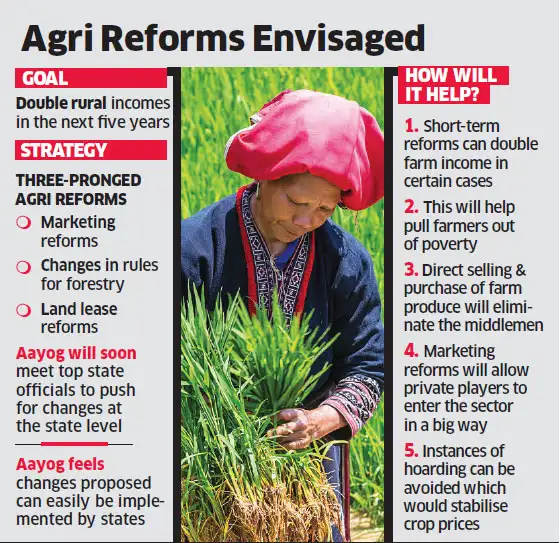
NITI Aayog has outline agriculture marketing reforms— which are being firmed up with ministry inputs. Govt has strongly pushed for liberalisation with States, though with mixed results. Govt is being urged to bring out legislation or take a hard stance. Reforms are important as they allow private sector to come into agricultural marketing. That edges out middle-men, builds new marketing infra and encourages excellent collaborations.
Must have reforms are:
1) Liberalising APMC - cuts the middle man, to get better prices
2) Private mandis - users, wholesalers buy direct from farmers
3) Digital technology - online buyers, higher productivity, ease of doing farming
4) Lifting of export bans and stock limits — so farmers are not forced to sell cheap in the domestic market
Examples of private sector contribution:
~~~~~~~~~~~~~~~
◘ We now grow mint with just 8 irrigations instead of 11. Water use is down 23% but yields are 68% higher. We save 30% water by modifying the distillation unit. Our farmers grow mint to our high standards.
— Mars Wrigley Confectionery
◘ We weeded out middlemen to improve incomes and motivate our farmers. We now provide technology to farmers through Start-ups.
— Army's Kitchen & Global Agrisystem
◘ Indian farmers receive new varieties, good farming practices, cutting edge technology. We pay well for superior potatoes -- so small and marginal farmers can have a good life.
— PepsiCo India
◘ We pioneered direct seeding tech, so water use for rice is down 30+%. We provide other techs as well. We brought quality palm plantings from Malaysia and trained Indian farmers to grow them. Our farmers need 25% less feed to raise poultry (1.5kg for 1kg bird weight).
— Godrej Agrovet (2m farmers!!)
◘ Our laser levellers for sugar cane fields help to conserve water. We value our farmers traditional skills so we provide small packages of technology to increase yields or make agriculture sustainable. Tech comes from co-opt with international partners.
— DCM Shriram
◘ In our cocoa sustainability program, we provide seedlings, know-how, post harvest processing. We also support Kerala & TN universities to find new varieties, that are much superior in terms of environment, pricing, growing characteristics.
— Mondelez India
◘ Micro-irrigation has raised yields of chillies & bananas by 30-35%. Our grape farmers have raised yields from 3-4 tonnes/ acre to 9-10 t/A!! MeraKisan, e-market start up has removed 6-8 middlemen, so our farmers get 10-15% returns on their investment. We will launch a full fledged digital service.
— Mahindra Agri Solutions
◘ We closely monitor points in the value chain to assess which variation sells. In this way, our farmers are aligned with customer demand, and get good markets or higher share of the retail price.
— ITC Agri & Tech
◘ Among many things, we disperse know-how on seeds, irrigation practices, agri techniques. We also guarantee to buyback of the produce.
— Hindustan Unilever
◘ Our HP apple growers have seen appreciable improvement in quality and price. We pay promptly online. We cut middlemen and operate a short, tight distribution. We help farmers to customise through packaging and grading, which is done at farm sites. In this way, we can sell to large buyers and reap profits for our farmers.
— Adani
◘ $2m donation to our agribusiness system gives small farmers means to link to different buyers, outside the normal, to fetch them better incomes.
—Walmart
REPLY Jan 16, 2018 - PM Modi govt's promise to double farming incomes, will need a big injection of private sector capital and enterprise. NITI Aayog wants govt to remove hurdles, simplify and give incentives so firms can double investments going into contract farming, transport, marketing, warehouses and food processing. India should be an outsourcing hub for global supermarket chains.
Indian states currently allow contract farming only for selective crops. The federal government has sought public comments for a model contract farming act unveiled in December. Higher investments by companies including PepsiCo., Hindustan Unilever Ltd., ITC Ltd., which buy from farmers in some states, could boost incomes faster than govt alone.
NITI Aayog is proposing that States assure market prices for important crops for them. Centre will bear part of States' loss.
REPLY Jan 17, 2018 REPLY Jan 17, 2018




Add a comment...

No comments:
Post a Comment